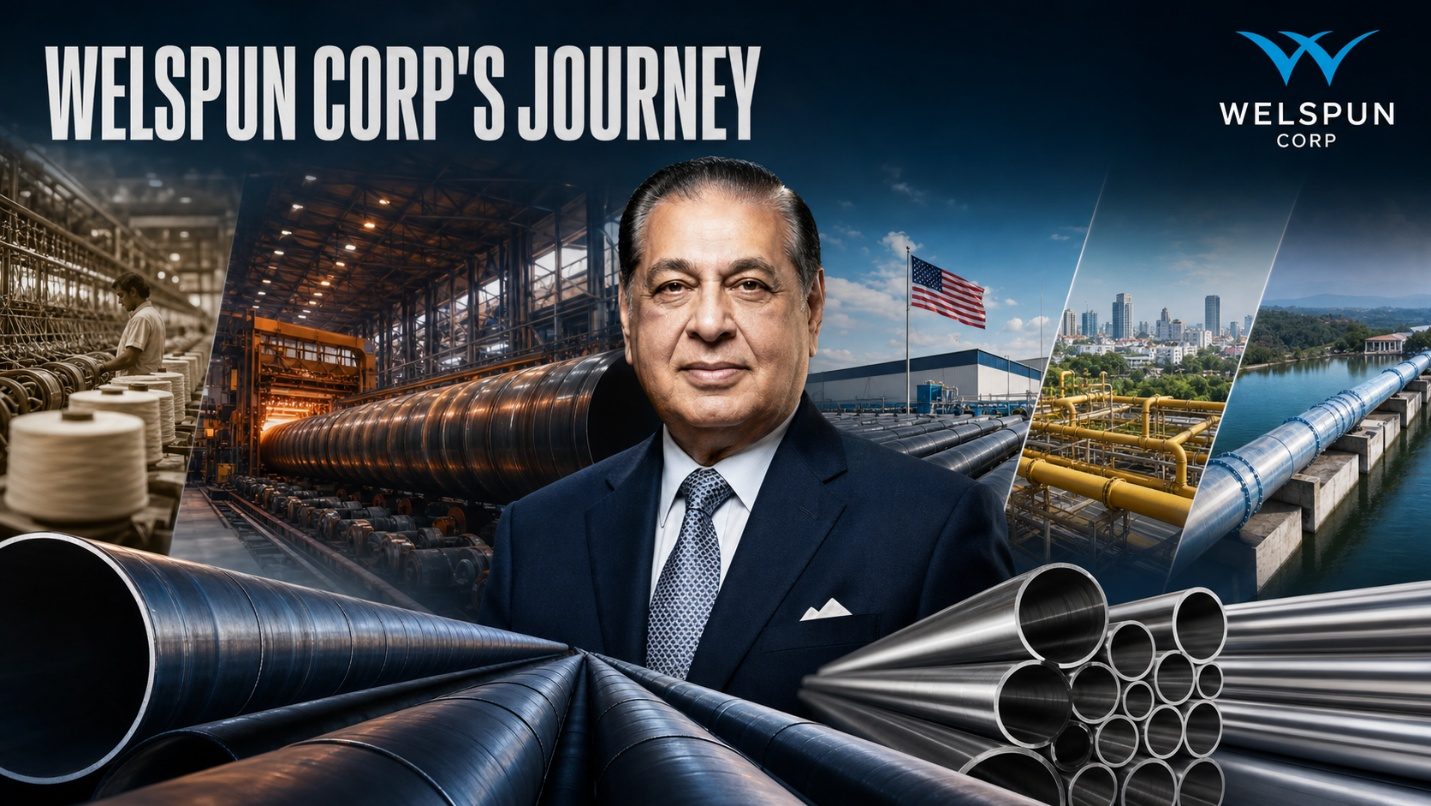
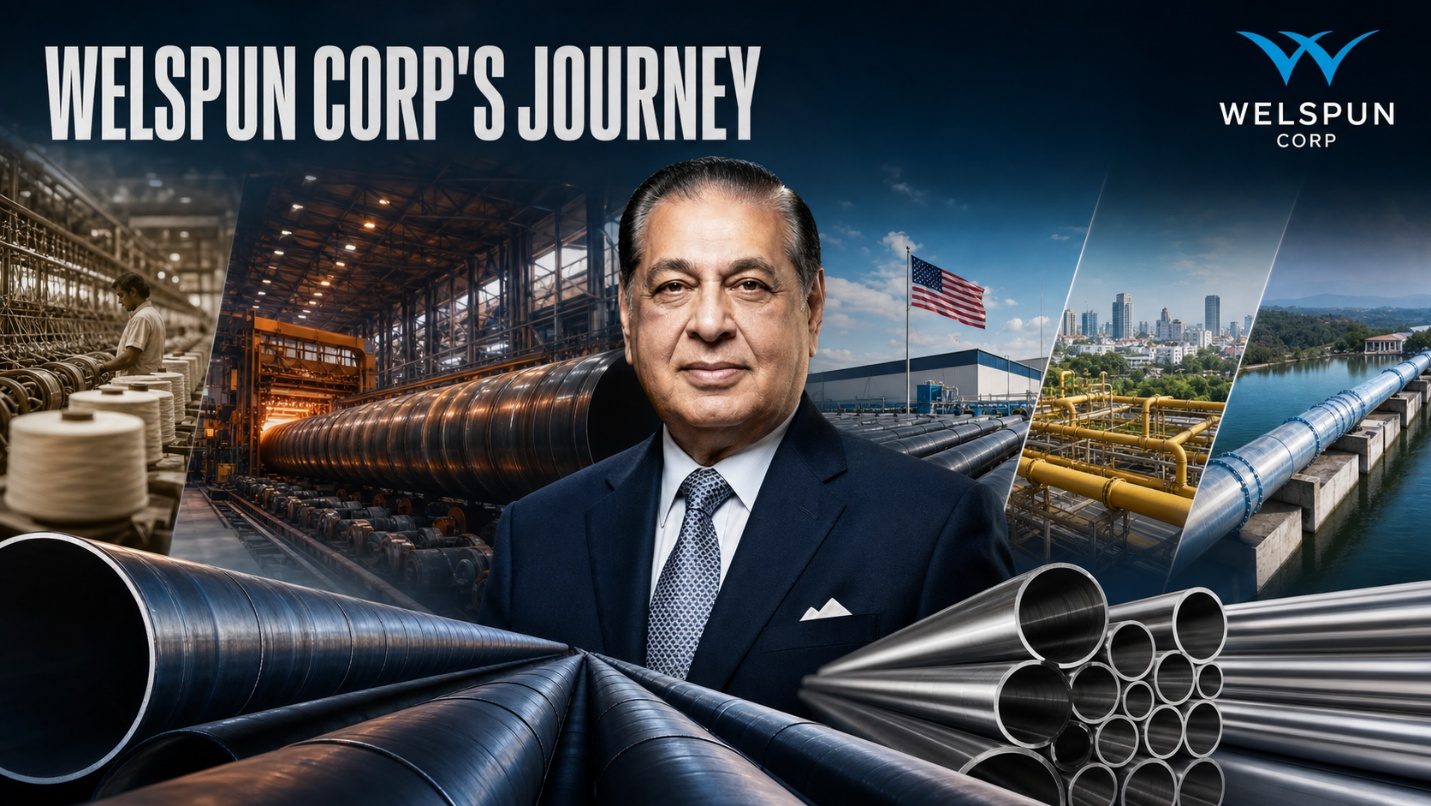
Welspun Corp is a global line-pipe franchise that turned into a national infrastructure franchise. For years the cycle waited for the customer to come back, and now it has three at once: oil, gas and water pipelines all ordering together. Long-cycle commodity engineering pays out precisely when several end markets line up. Here is the journey, year by year.
- The Welspun Group began in textiles in 1985; Welspun Corp was set up in 1995 to make line pipes.
- It became one of the world’s largest line-pipe makers, with a US plant and Indian capacity.
- Indian city-gas, Jal Jeevan water and oil pipeline cycles converged from 2021.
- By FY25 revenue was around ₹14,000 crore with an order book of roughly ₹19,500 crore.
- FY25 Revenue is around ₹14,000 crore with profit around ₹1,900 crore and an order book of roughly ₹19,500 crore.
1985 B.K. Goenka founds the Welspun Group in Palghar, Maharashtra, initially in yarn texturising.
1995 Welspun Corp is incorporated to manufacture line pipes for oil, gas and water transmission.
2005 It becomes one of the world’s largest line-pipe manufacturers.
2007 It builds a greenfield line-pipe plant in the United States (Little Rock, Arkansas) and expands Indian capacity.
2014–2019 Oil and gas pipeline orders soften globally.
2021 India’s city-gas-distribution build-out and accelerating PNGRB pipeline tenders revive demand.
2023 It acquires Sintex BAPL for piping integration, and water-infrastructure orders scale through the Jal Jeevan Mission.
2024 Defence pipes and stainless-steel pipes are added via the Welspun Specialty Solutions integration.
2025 India’s gas, water and oil pipeline cycles all run together, with multi-year order visibility across pipe types.
2026 Welspun Corp has multi-year visibility across three pipeline cycles at once.
The pattern is the point
Welspun Corp is a global line-pipe franchise that became a national infrastructure franchise, and the cycle simply waited for the customer to return, it now has three. Long-cycle commodity engineering pays out when oil, gas and water pipelines order at the same time, which is exactly the position the order book describes.