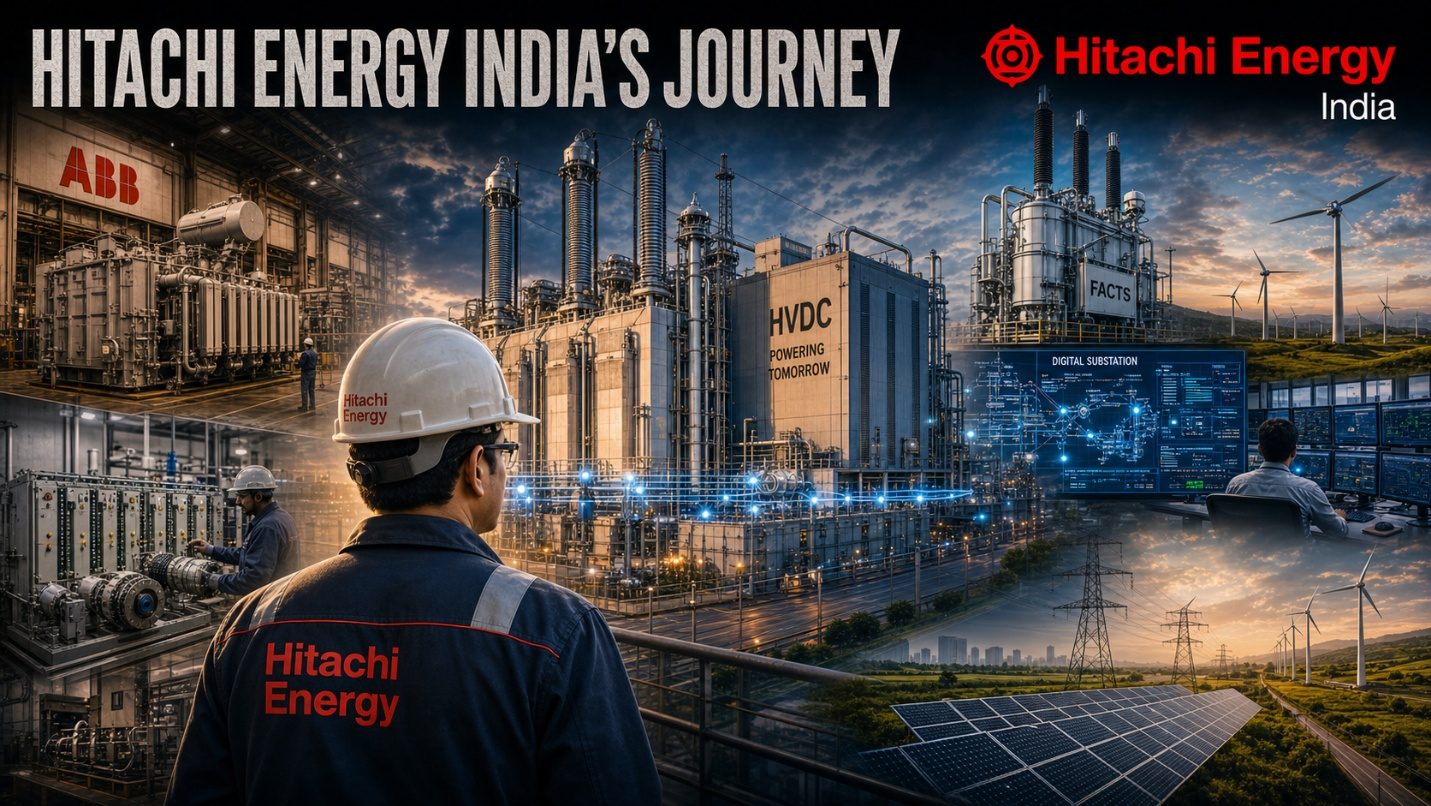
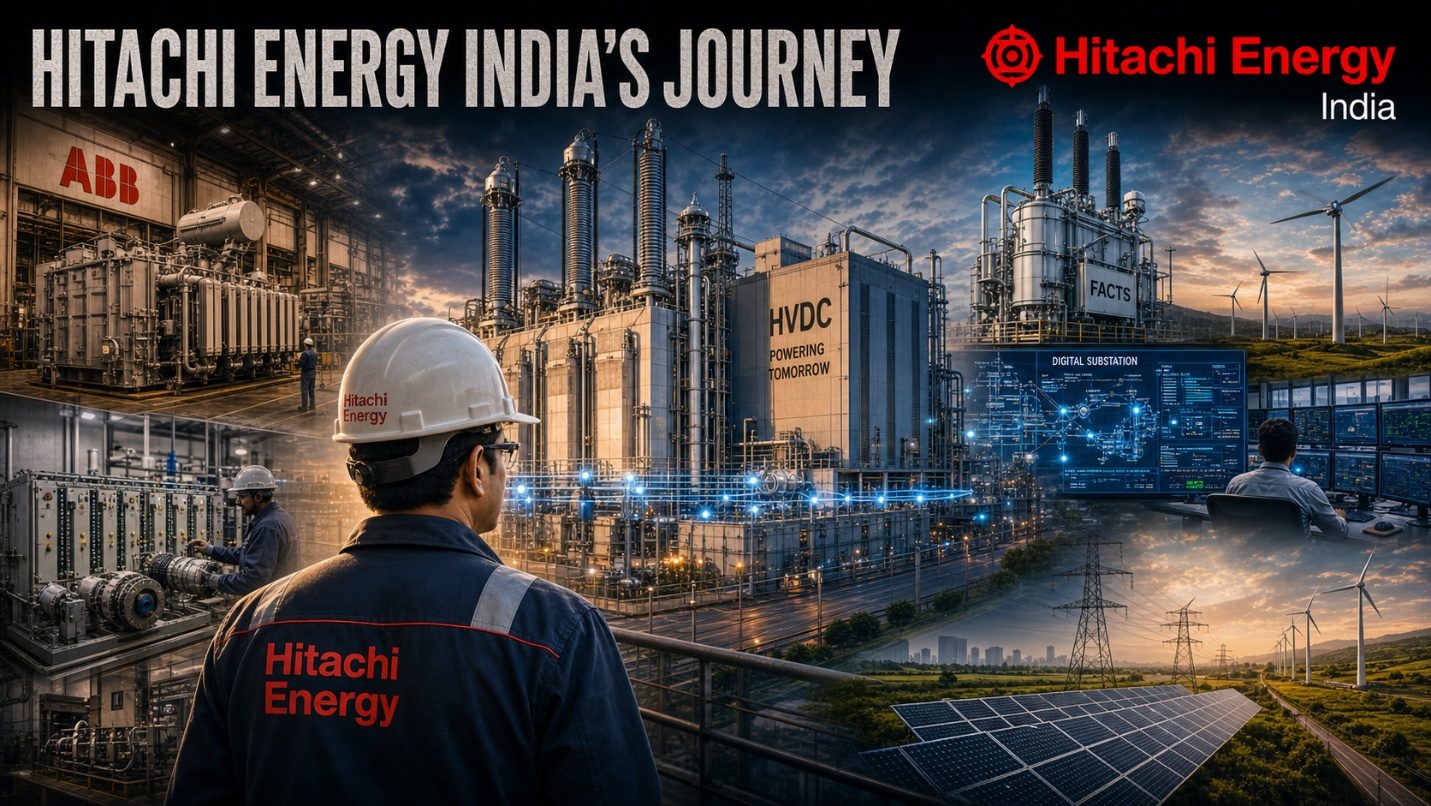
India is rebuilding its electricity grid from a thermal-dispatch architecture to a renewable-dispatch one, and that build-out runs on HVDC, FACTS devices and digital substations. Hitachi Energy India is one of only two listed names that can deliver HVDC at scale, a near-monopoly inside the largest grid spend the country has ever attempted. Here is the journey, year by year.
- The business traces its India roots to 1949 (as The Hindustan Electric Company, later Hindustan Brown Boveri, and from 1989 ABB India) and scaled across transformers, switchgear and grid automation.
- Hitachi acquired 80.1% of ABB’s global power-grids business (~$11 billion enterprise value) in 2020.
- The Indian listed entity was renamed Hitachi Energy India in November 2021, focused on HVDC and grid tech.
- By FY25 revenue reached ~₹6,440 crore with record order inflows of ~₹18,170 crore.
1949 India operations begin — incorporated as The Hindustan Electric Company Limited (later Hindustan Brown Boveri, then ABB India).
1988 ASEA merges with BBC Brown Boveri globally to form ABB (announced 1987), and ABB India scales across transformers, motors, drives, robotics, switchgear and grid automation.
2018 ABB announces globally that its power-grids business will be hived off.
Dec 2019 – Mar 2020 ABB India demerges its power-grids business into ABB Power Products and Systems India Ltd, which lists on BSE and NSE.
Jul 2020 Hitachi completes its acquisition of 80.1% of ABB’s global power-grids business (~$11 billion enterprise value).
Nov 2021 It is renamed Hitachi Energy India, narrowing focus to HVDC, FACTS, transformers, gas-insulated switchgear and grid automation.
FY25 Revenue reaches ~₹6,440 crore, margins expand, and order inflows hit a record ~₹18,170 crore (backlog ~₹19,250 crore).
FY25 The order book hits record levels (~₹19,250 crore backlog) as Power Grid Corporation awards major HVDC projects (Khavda–Nagpur, Bhadla–Fatehpur).
2025 India’s renewable grid is built on Hitachi Energy technology, the order book offers multi-year visibility, and HVDC is flagged as the structural growth driver.
2026 It is one of two listed names able to build HVDC at scale in India, a near-monopoly inside the largest grid spend the country has ever attempted.
The pattern is the point
India is re-architecting its grid for renewables, and that build-out requires the HVDC, FACTS and digital-substation hardware Hitachi Energy India makes. With only two players able to deliver HVDC at scale and a capex cycle that has roughly a decade to run, the result is a near-monopoly inside the largest grid spend India has ever attempted.