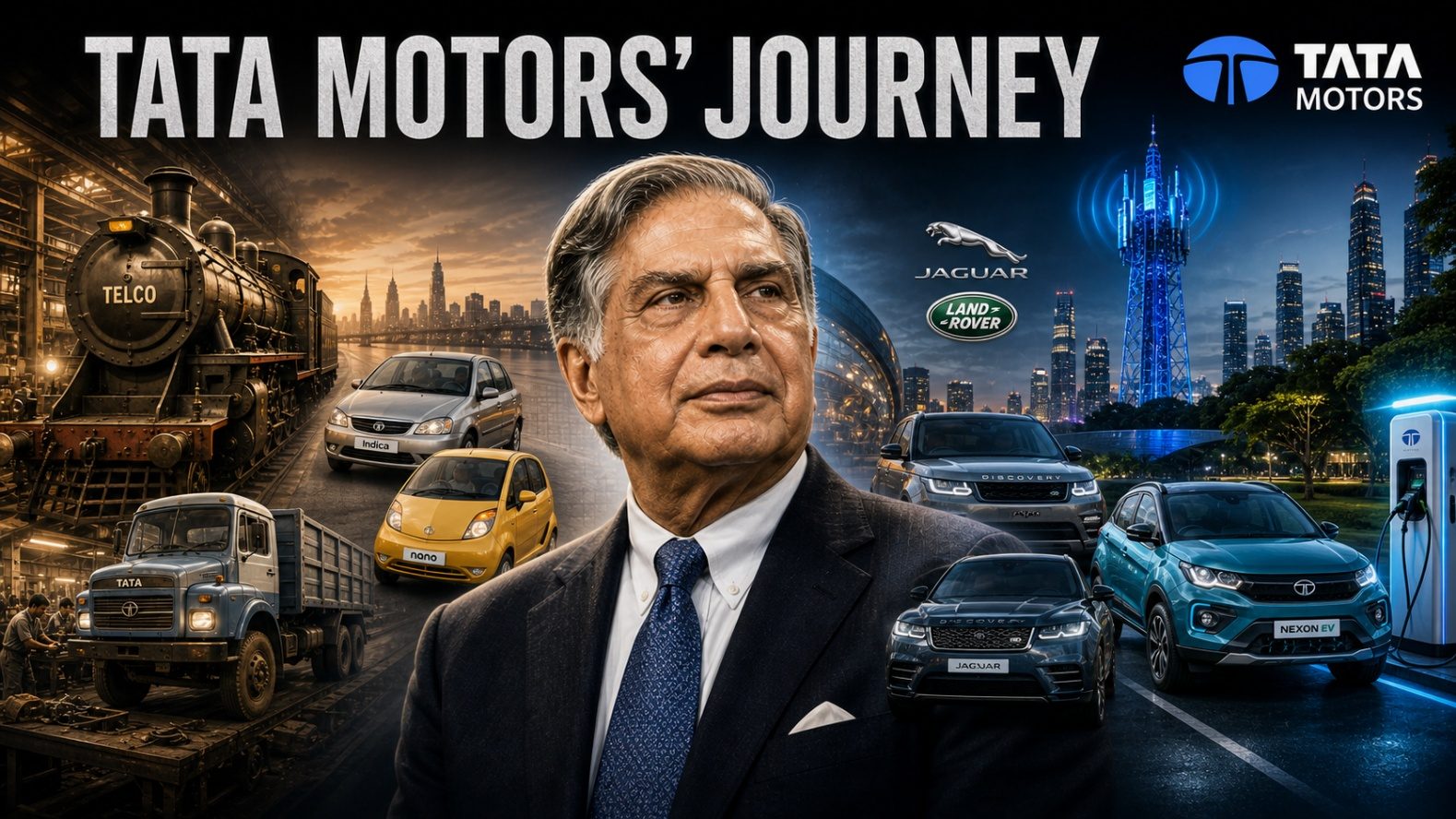
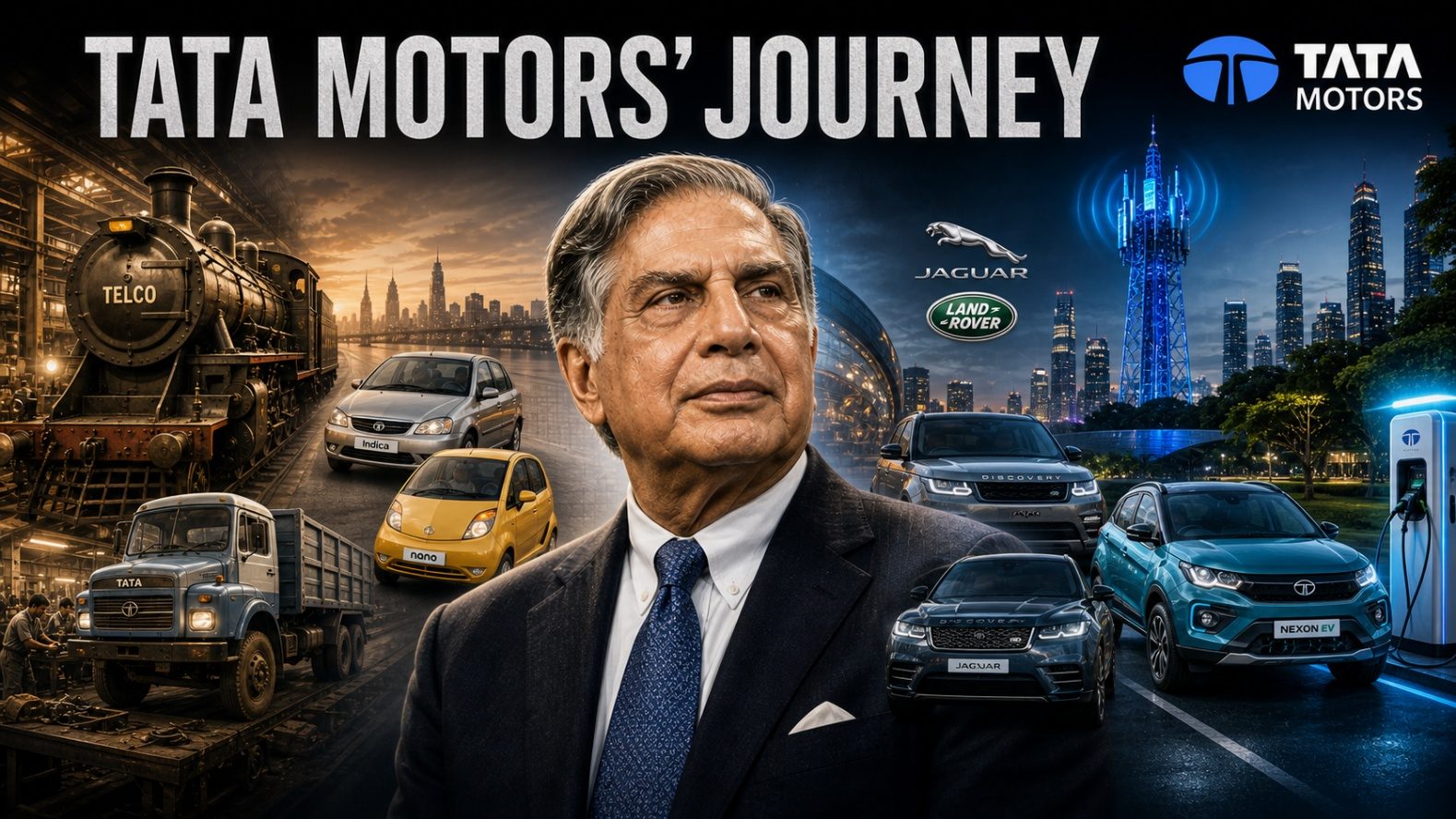
Tata Motors is, in many ways, the story of Indian industry itself, built to make the machines a young nation could not yet make for itself, and repeatedly betting on the next era of mobility before the market believed in it. From steam locomotives to the world’s cheapest car to British luxury marques to electric vehicles, almost every chapter looked like a stretch when it began and obvious in hindsight. Here is that journey, year by year.
- Tata Motors began in 1945 as TELCO, making steam locomotives, and built India’s truck industry from 1954.
- Its $2.3 billion purchase of Jaguar Land Rover in 2008, at the depth of the financial crisis, was called suicidal, then became its most profitable arm.
- The Nano (2009) flopped, but the Nexon EV (2020) made Tata India’s clear electric-vehicle leader.
- A 2024 demerger splits the group into a pure-play EV/PV company and a commercial-vehicle business, completing in 2025.
1945 Founded as Tata Engineering and Locomotive Company (TELCO) to build steam locomotives for the railways, heavy engineering for a country about to industrialise.
1954 Its first commercial vehicle rolls out in collaboration with Daimler-Benz, effectively starting India’s modern truck industry.
1991 The Tata Sierra arrives, India’s first fully indigenous passenger vehicle, proving the company could design, not just license.
1998 The Tata Indica becomes the first passenger car designed and built in India, a genuine national milestone.
2004 Tata acquires Daewoo’s commercial-vehicle business in South Korea, its first big overseas deal, and becomes the first Indian automotive company to list on the New York Stock Exchange.
2008 Tata buys Jaguar Land Rover from Ford for $2.3 billion in the worst week of the global financial crisis. The market calls it suicide; in time JLR becomes the most profitable car business India has produced.
2009 The Tata Nano launches as the world’s cheapest car, a feat of engineering that becomes one of India’s most famous product failures, undone by positioning, not capability.
2017 Under Ratan Tata’s strategic reset, the company quietly pivots toward electric vehicles while rivals hesitate.
2020 The Nexon EV launches as India’s first mass-market electric car, seeding a lead the competition is still chasing.
2023 Tata Motors crosses roughly 70% of India’s electric-vehicle market, a near-monopoly in the segment everyone now wants.
2024 A demerger is announced, splitting the passenger-vehicle and commercial-vehicle businesses into two separately listed entities.
2025 Jaguar Land Rover delivers a record annual profit after decades of cyclical losses, vindicating the 2008 gamble.
2025 The passenger-vehicle demerger completes: an Indian EV pure-play emerges, with Land Rover and Jaguar as its global premium arm.
The pattern is the point
Tata Motors has owned every era of Indian mobility, trucks, the first indigenously designed cars, the cheapest car ever built, premium British marques, and now the electric transition. Each move looked like an overreach when it was made and inevitable once it paid off. The through-line is patience: the willingness to own the right business through the wrong decade, and to keep paying the holding cost until the cycle finally turns.