It began as a plan to buy second-hand missiles. It ended with one company running the planet’s launch infrastructure. Here is how SpaceX got there, year by year.
2001 Frustrated that NASA had no real plan to reach Mars, Musk flies to Moscow to buy refurbished Soviet intercontinental missiles to loft a small “Mars Oasis” greenhouse. The Russians mock him and quote impossible prices; on the flight home he opens a spreadsheet and concludes he can build rockets himself for a fraction of the cost.
2002 He founds Space Exploration Technologies, SpaceX, in a warehouse in El Segundo, California, on 14 March, seeding it with roughly $100 million from his PayPal exit and a goal almost everyone calls delusional: to make humanity multiplanetary.
2006 The first Falcon 1 lifts off from a Pacific atoll and fails about thirty-three seconds in, when a corroded aluminium nut leaks fuel and the engine catches fire. The rocket falls back to the island.
2007 The second Falcon 1 flies far higher, but sloshing propellant and an early engine shutdown leave it just short of orbit. Two failures down, the company’s cash is draining fast.
Aug 2008 The third Falcon 1 fails when the spent first stage bumps the second after separation. SpaceX now has money for perhaps one more launch, and Musk, bankrolling both SpaceX and Tesla through the crash, is close to personal bankruptcy.
28 Sep 2008 The fourth Falcon 1 reaches orbit, the first privately built, liquid-fuelled rocket ever to do so, for a total programme cost under $100 million, a sliver of any government effort.
23 Dec 2008 NASA awards SpaceX a $1.6 billion contract for twelve cargo runs to the ISS. Arriving days before the company would have run dry, the deal saves SpaceX outright.
Jul 2009 Falcon 1’s fifth and final flight places a Malaysian satellite in orbit, the first private company to deliver a commercial payload, before SpaceX retires the little rocket to focus on the far larger Falcon 9.
Jun 2010 Falcon 9, with nine engines clustered in its first stage, succeeds on its debut, giving SpaceX a rocket big enough for cargo, crew and, one day, entire constellations.
Dec 2010 On Falcon 9’s second flight the Dragon capsule orbits Earth twice and is recovered from the Pacific, the first time a private company has brought a spacecraft back from orbit, a feat previously managed only by nations.
May 2012 Dragon docks with the ISS and unloads cargo, the first commercial spacecraft to reach the station, the moment private spaceflight stops being a promise and becomes a service.
Dec 2015 After a string of fiery near-misses on barges and pads, a Falcon 9 first stage returns from space and lands upright at Cape Canaveral. For the first time, an orbital booster can be flown, recovered and flown again.
Mar 2017 SpaceX launches a satellite on a previously flown, recovered Falcon 9 booster and lands it a second time. Reusability moves from stunt to standard practice, and launch prices begin to fall.
Feb 2018 Falcon Heavy debuts as the most powerful rocket flying, its two side boosters touching down in near-perfect synchrony while a Tesla Roadster and its spacesuited “Starman” sail off toward the orbit of Mars.
May 2019 The first sixty Starlink satellites go up, the opening salvo of a constellation meant to blanket the planet in broadband and turn one-off launches into recurring monthly revenue.
May 2020 Crew Dragon’s Demo-2 carries two NASA astronauts to the ISS, the first crewed orbital launch from US soil since 2011, and the first ever by a private company, ending American dependence on Russian Soyuz seats.
Sep 2021 Inspiration4 sends an all-civilian crew, with no professional astronauts aboard, around the Earth for three days, the first wholly private orbital human spaceflight.
Apr 2023 Starship, the largest and most powerful rocket ever built, lifts off on its first integrated test. It clears the pad but tumbles and is destroyed minutes later, an explosive, data-rich beginning the company treats as progress.
Oct 2024 On Starship’s fifth flight, the launch tower’s “chopstick” arms pluck the returning Super Heavy booster out of the sky, the first mid-air catch of an orbital-class booster, and a giant step toward full, rapid reuse.
2026 SpaceX now puts more than 80% of the world’s mass into orbit, runs over 10,000 active Starlink satellites, has flown Falcon 9 more than 600 times at a reuse rate above 90%, and is operating Starship, driving the cost per kilogram to orbit toward $100, the price at which space begins to industrialise.
The pattern is the point
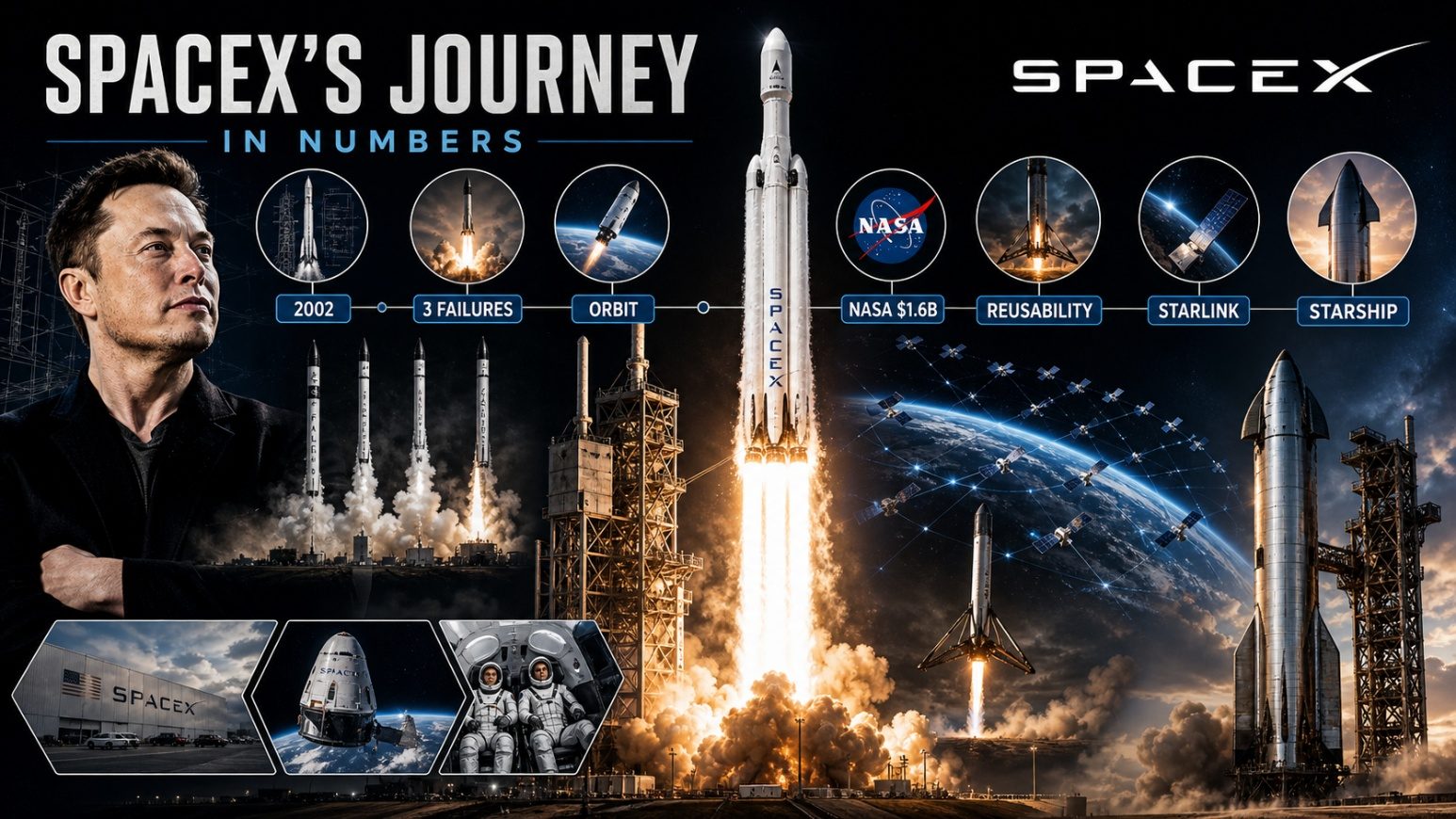
Three failures, then orbit. NASA’s bet saves the company. Reusability rewrites the economics. Starlink turns single launches into recurring revenue. Starship turns Mars from a moonshot into an engineering question. The world’s launch infrastructure is now run by one company, started twenty-four years ago by someone who had been told the math did not work. The next chapter is not being written on this planet.
This blog is for information and general interest only. It is not investment advice or a recommendation regarding any company or security. Figures and dates are drawn from public sources.