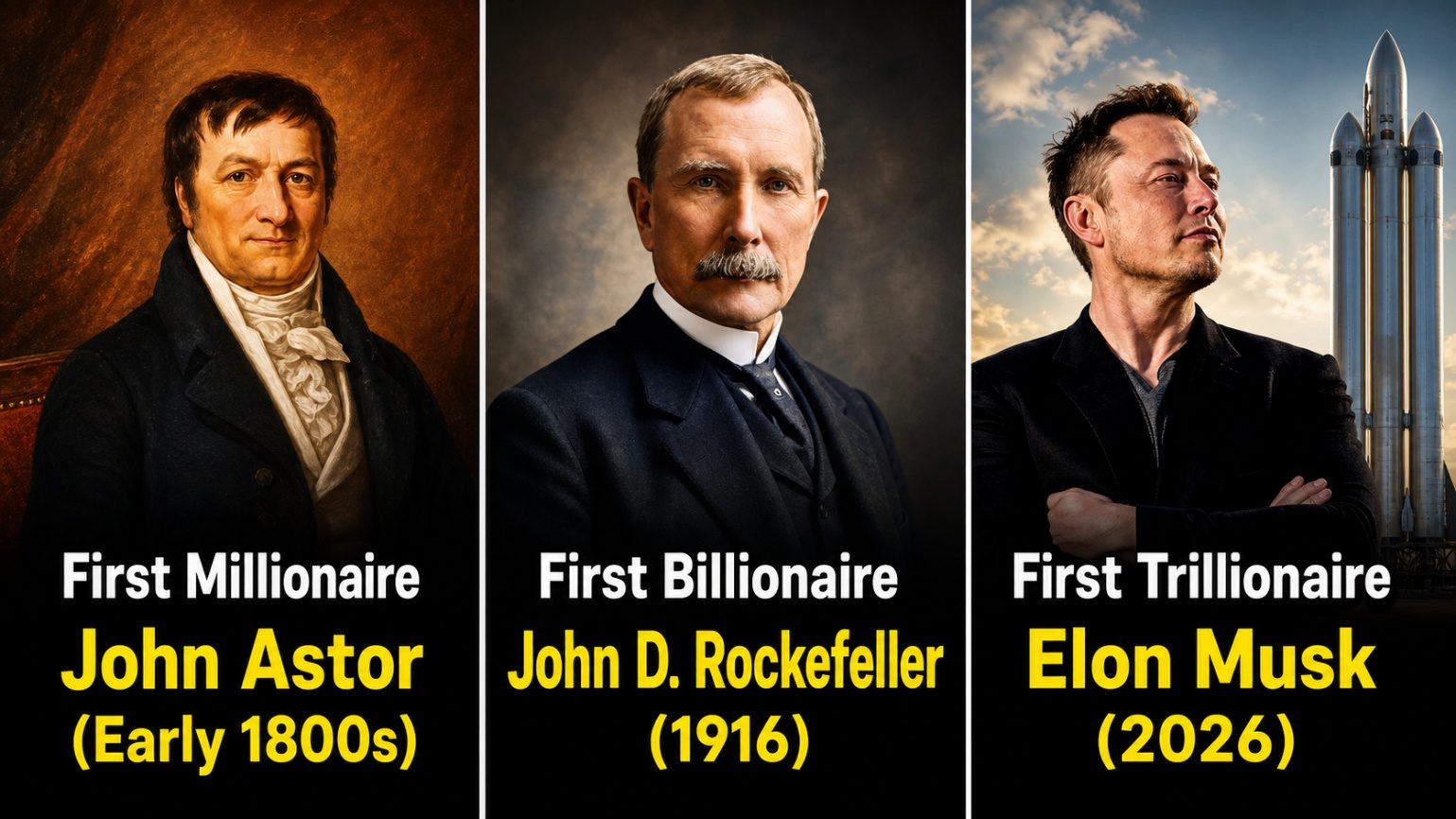
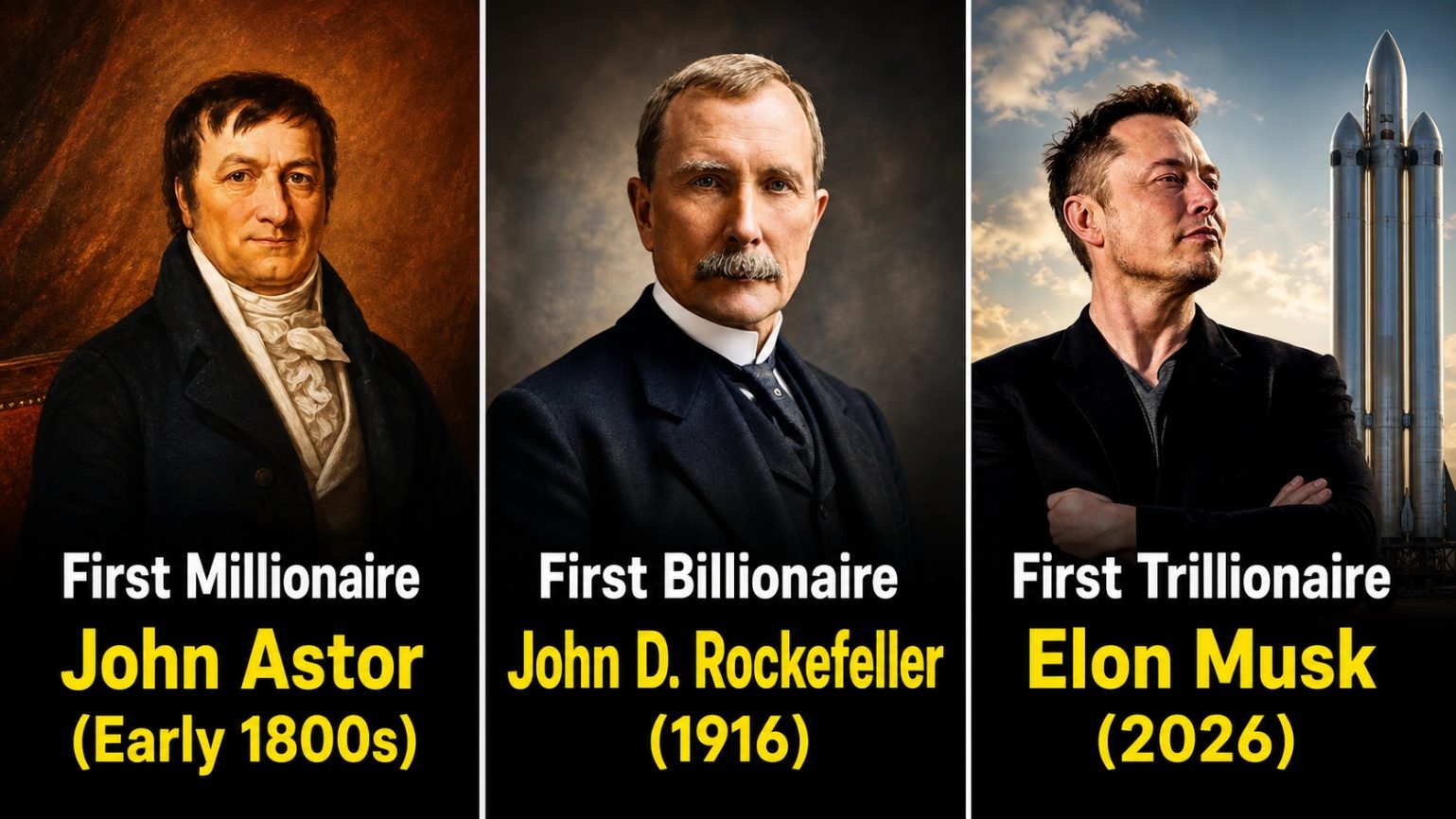
Every age has had one figure who built the infrastructure the rest of the century ran on, and who, almost as a side effect, became the richest person of their time. Three men, across three centuries, tell that story: a fur trader who ended up owning Manhattan, an oil refiner who organised an entire industry, and a rocket builder now pricing the next hundred years. The scale of the fortunes is wildly different. The pattern that produced them is almost identical.
John Jacob Astor (1763–1848): the first American millionaire
John Jacob Astor arrived in New York in 1784, a penniless German immigrant of twenty said to be carrying a few flutes to sell. He built the American Fur Company into the country’s first great business monopoly, shipped furs to China and brought back tea and silk, and even founded the trading post of Astoria on the Pacific coast. Then, with a trader’s instinct for tops, he sold out of furs in the 1830s, just as the trade peaked, and poured everything into Manhattan real estate, buying farmland and woodland that would become Midtown. By the time he died in 1848 he was the richest man in America, his roughly $20 million estate reportedly larger than the cash in the United States Treasury. His deathbed words were not advice but a regret: “Could I begin life again, knowing what I now know, and had money to invest, I would buy every foot of land on the Island of Manhattan.”
John D. Rockefeller (1839–1937): the first billionaire
John D. Rockefeller did not strike oil; he organised it. From his first Cleveland refinery in 1863 he obsessed over cost, driving the price of refining a gallon of kerosene down from roughly three cents toward one, and using efficiency and hard-nosed railroad rebates to undercut and absorb rival after rival. By the early 1880s his Standard Oil controlled around 90% of American refining. When the Supreme Court broke it up in 1911, into the ancestors of Exxon, Mobil, Chevron and Amoco, the pieces proved worth more apart than together, and the breakup made him richer still. He crossed a billion dollars in 1916 at seventy-seven, a fortune equal to a far larger slice of the US economy than any modern billionaire’s, then spent his final twenty-one years giving most of it away; the University of Chicago, Rockefeller University and the Rockefeller Foundation are all that second act.
Elon Musk (1971– ): the first trillionaire
Elon Musk made his first fortune in software, about $180 million when eBay bought PayPal in 2002, and then did the unthinkable with it, pouring it into rockets and electric cars when both looked like reliable ways to go broke. SpaceX drove the cost of reaching orbit down by roughly 90% through reusable rockets; Tesla made electric vehicles mainstream and, for a time, the most valuable car company in history. On top of those he stacked xAI, Neuralink, The Boring Company and Tesla Energy, each attacking a different hard physical problem: artificial intelligence, brain interfaces, tunnelling, energy storage. In 2026, as SpaceX’s record listing and his other stakes were marked to market, he became the world’s first trillionaire. The trillion was never really a stock price; it was the sum of one person betting on almost every infrastructure problem of the coming century at once.
The pattern
Strip away the centuries and the three stories rhyme. Each man built the physical layer the next era would depend on, land, then energy, then access to space itself. Each reinvested with a discipline bordering on obsession, refusing simply to cash out. Each was, in his moment, doing something the establishment dismissed as reckless or absurd. And each, at the peak or near the end, turned toward giving the fortune away or spending it on something larger than money. The wealth was the by-product. The infrastructure was the point, and it outlasted all three.
This blog is for information and general interest only. It is not investment advice or a recommendation regarding any company or security. Figures and dates are drawn from public sources.