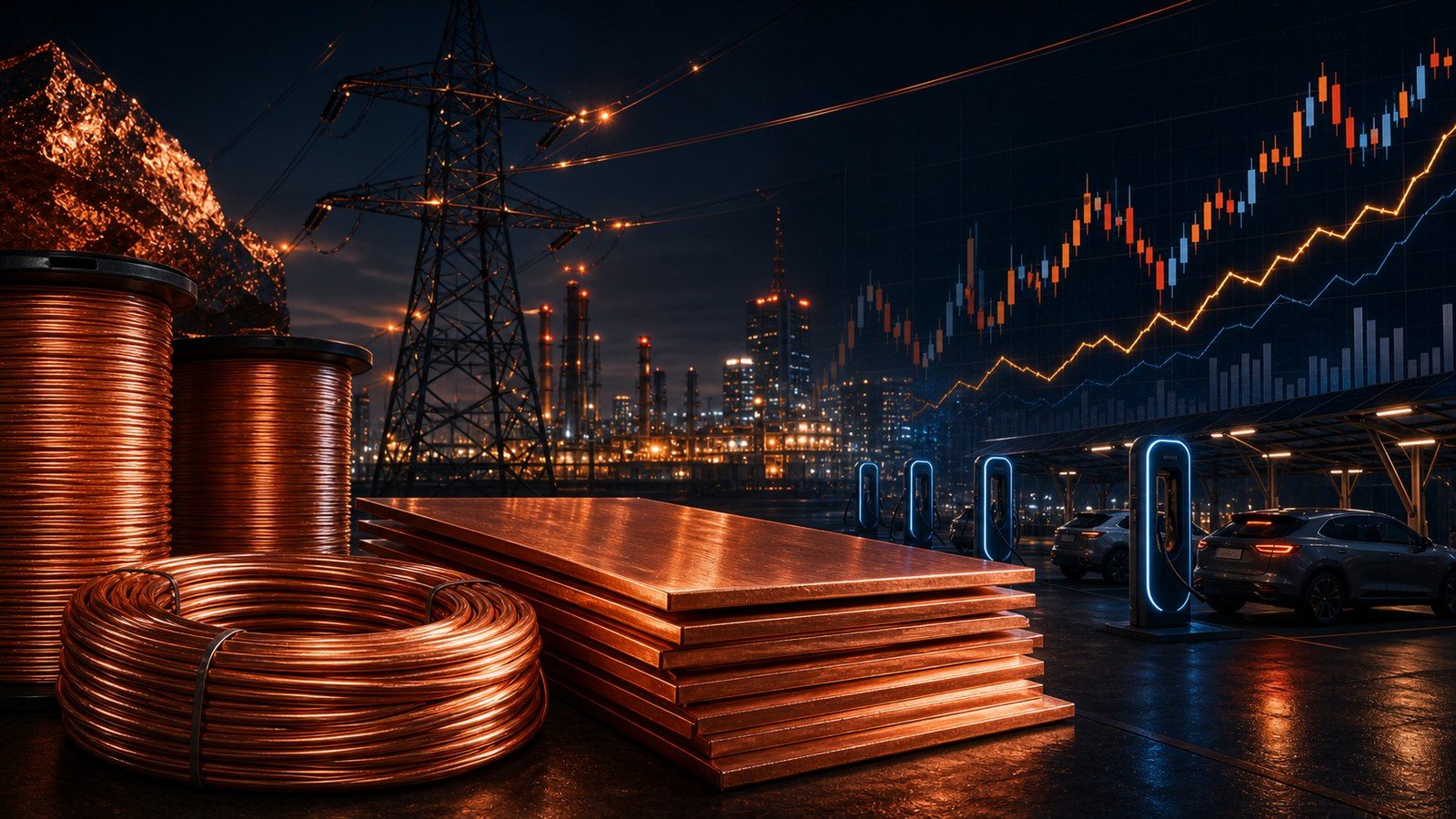
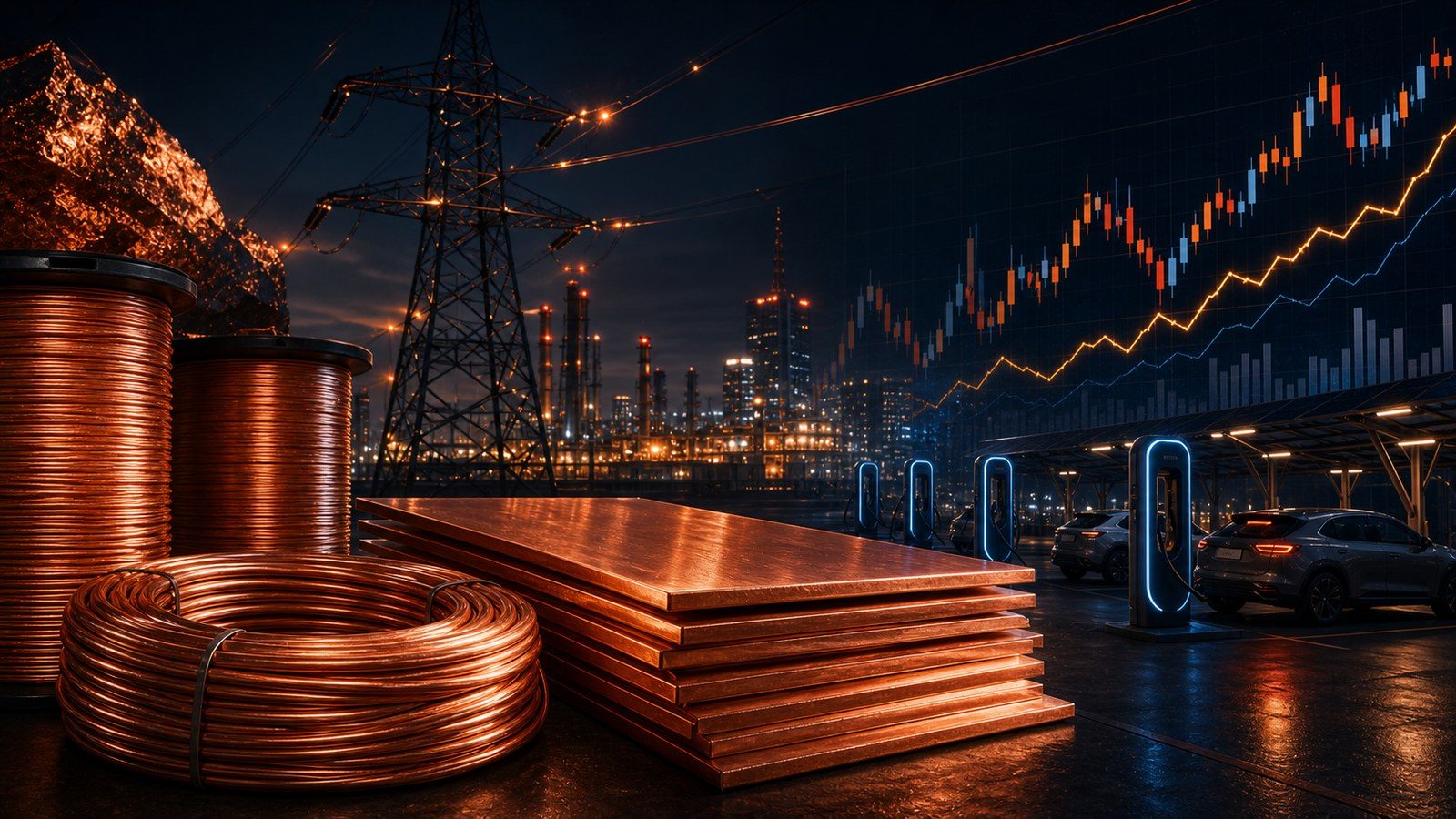
- Copper hit record highs in 2026 ($14,527.50/t on the LME), not on a booming economy, but on a structural rewiring of the world.
- The near-term balance is a coin-toss, but the decade-ahead deficit is the clearest structural case in commodities.
- AI data centres are a powerful new demand pillar nobody had modelled three years ago, up to 50,000 tonnes of copper per large site.
- Supply is geologically constrained: ore grades down ~40% since 1991, ~17-year lead times, a zero treatment-charge benchmark and a run of mine disruptions.
- India sits squarely in the path of the shortage, imports surging, demand set to double by 2030, and Adani, Hindalco and others scrambling to build capacity.
- Markets have long called copper “Dr Copper,” the metal with a PhD in economics, because its price has historically taken the temperature of global growth. In 2026 the doctor is delivering a different diagnosis. Copper touched fresh records this year, the London benchmark hit an all-time high of $14,527.50 a tonne on 29 January 2026, and the US COMEX contract peaked at $6.716 a pound on 13 May, and it has held firm around $6.40 a pound since, even as global growth wobbled. The reason the old barometer is reading high in a soft economy is that copper has stopped being purely a growth play and become a structural one. The world is rewiring itself, for electrification, for renewables, for electric vehicles and now, suddenly, for artificial intelligence, and every one of those wires is made of copper. Over the coming decade, the supply of the metal looks unlikely to keep up.
A balance that is tightening beneath the surface
The near-term picture is genuinely contested, and it is worth being precise about it. After a modest surplus of roughly 178,000 tonnes in 2025, the official International Copper Study Group now expects a small 2026 deficit of about 150,000 tonnes, a reversal from the roughly 209,000-tonne surplus it had pencilled in back in April, driven by mine disruptions and tighter concentrate supply. Several investment banks see it very differently, UBS pencils in a 2026 deficit of around 500,000 tonnes and Morgan Stanley something similar, so the “is the market in deficit yet?” question is a live debate rather than a settled fact. What is not in debate is the longer view, and that is where the case lives. The International Energy Agency warns that on current trends the world faces a copper supply shortfall of about 30% by 2035; Wood Mackenzie estimates that meeting demand will require nearly eight million tonnes of brand-new mine supply plus three and a half million tonnes of additional recycling by 2035, and more than $210 billion of investment to get there; and S&P Global sees the gap widening toward ten million tonnes a year by 2040 as demand climbs by half. Whichever forecast you take, they point the same way, toward a structural gap between what the world will want and what it can dig up.
Demand: the old drivers, plus a powerful new one
The demand side is where copper’s story has genuinely changed. The familiar pillars are formidable enough: an electric vehicle uses around 80 kilograms of copper against roughly 20 for a petrol car, four times as much, and EV sales reached about 21.6 million units in 2025; a megawatt of solar capacity needs around 5.5 tonnes of copper, and offshore wind ten to fifteen. But the new pillar is the one almost nobody had modelled three years ago, artificial intelligence. A single large AI data centre can require up to 50,000 tonnes of copper for its power distribution and cooling, and analysts at S&P Global estimate data-centre demand alone could rise toward 1.1 million tonnes a year by 2030, around 3% of the entire global market, and toward 2.5 million tonnes by 2040, from a standing start. Stack these on top of ageing power grids that must be rebuilt across the developed and developing world, and total copper demand, roughly 27–28 million tonnes today, is projected to push past 40 million tonnes by 2040. China still consumes around 58% of the world’s refined copper, but the incremental growth is increasingly coming from electrification everywhere.
Supply: slow, hard, and getting harder
If demand is accelerating, supply is doing the opposite, for reasons that are geological as much as financial. The average grade of mined copper ore has fallen roughly 40% since 1991, meaning miners must move ever more rock for the same metal. Major new discoveries have dried up, and the time from finding a deposit to producing from it has stretched to about seventeen years. On top of these slow structural pressures, 2025 and 2026 brought a run of acute disruptions: a fatal mud rush at Freeport’s giant Grasberg mine in September 2025 is expected to cut its output by around 35% in 2026, with a full ramp-up now delayed twelve to eighteen months and the operator’s group copper-sales guidance trimmed to about 3.1 billion pounds; a deadly collapse at Codelco’s El Teniente in Chile killed six; and First Quantum’s huge Cobre Panamá mine has sat shut since 2023. Perhaps the most telling signal comes from the smelters: the fee that miners pay processors to turn concentrate into metal, the treatment charge, collapsed to zero for 2026, the first-ever zero benchmark, and spot charges turned deeply negative, around minus $60 a tonne. When smelters are effectively paying for the privilege of processing ore, the raw material is scarce.
Tariffs, and what the forward case looks like
A uniquely 2026 wrinkle sits on top of the fundamentals: US trade policy. A 50% tariff on semi-finished copper has applied since April 2026, and Washington is weighing a phased duty on refined copper, 15% from January 2027, rising to 30% in 2028, with a key Commerce report due at the end of June. The prospect has pulled metal toward the United States, where traders have parked an estimated half a million tonnes in warehouses to beat the tariff, opening a persistent premium of COMEX prices over London. Through all of it, the analyst community has stayed constructive. Citi turned outright bullish in June 2026, forecasting roughly $14,500 a tonne within a month and $15,000 within a year; Bank of America models a 2027 average near $13,500 with a peak call of $15,000; Goldman Sachs, which has lifted its near-term targets to a roughly $13,700–13,800 area, still sees $15,000 by 2035; and Morgan Stanley and JPMorgan cluster their targets in the $10,600–12,500 range. The common thread is that today’s price, already near records, is treated as a waypoint rather than a ceiling, because the deficit is a function of physics and lead times rather than sentiment. The risks are real, a deeper downturn in China’s property sector, the substitution of cheaper aluminium in some wiring, a rise in scrap supply, and the very tariff distortions described above. But none of these dissolves a supply gap measured in millions of tonnes.
The India lens
For India the copper story is unusually direct, because the country is on the wrong side of the global shortage and racing to fix it. Since the abrupt closure of Vedanta’s Sterlite smelter at Tuticorin in 2018 wiped out nearly half of domestic capacity, India has been a net importer of refined copper; cathode imports have climbed from around 39,000 tonnes in 2017 to over 300,000 tonnes in 2024, and the country’s total copper import bill now runs to around $10 billion a year. Demand is set to roughly double from about 1.7 million tonnes today to over 3 million by 2030 on the back of the same grid, EV and renewables push driving the rest of the world, and India’s per-capita copper use, at around 0.6 kilograms against a world average of 3.2, signals just how long the runway is. The domestic response is now under way: Adani’s Kutch Copper smelter at Mundra, set to be the world’s largest single-site copper plant, has brought its first 500,000-tonne phase online and aims for a million tonnes by the end of the decade, while Hindalco, Hindustan Copper and a reviving Vedanta round out the push. There are growing pains, India’s new quality-control rules now recognise only a handful of certified cathode suppliers, and the country’s new smelters are scrambling for ore, with Adani and Hindalco reportedly hunting copper assets in Peru to secure feed. For investors, copper is less a trade than a way to own the single most important physical input into India’s, and the world’s, electrification.
The takeaway
Of the three metals, copper offers perhaps the cleanest structural case, because its bull argument needs no help from fear or monetary policy, only from the wires the modern economy is built out of. The near-term balance may be a coin-toss between a small surplus and a small deficit, but the decade ahead is not: demand pulled higher by electrification, electric vehicles, grids and the entirely new appetite of AI data centres, while supply is held back by falling ore grades, vanished discoveries, seventeen-year lead times and a string of mine disruptions. The analysts who price it for a living see higher prices ahead, and India sits squarely in the path of the shortage as one of its fastest-growing buyers. Copper will swing with the global cycle, as it always has. But the doctor’s longer-term prognosis is hard to argue with: the world is going to need far more of this metal than it currently knows how to produce.
It is not investment advice or a recommendation to buy or sell copper or any security. Prices, forecasts and analyst views are reported for context and can change rapidly. Please consult a registered financial adviser before making any investment decision.