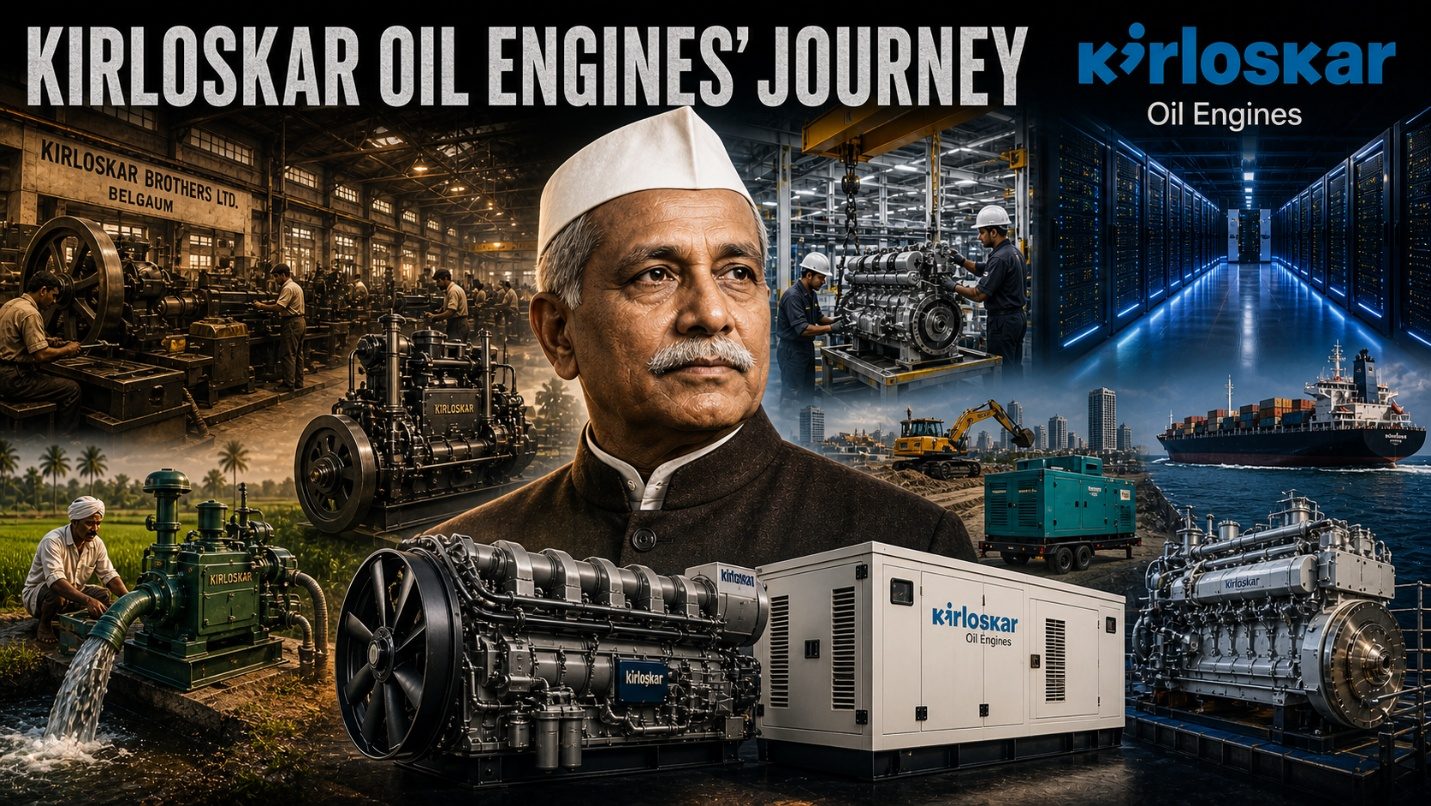
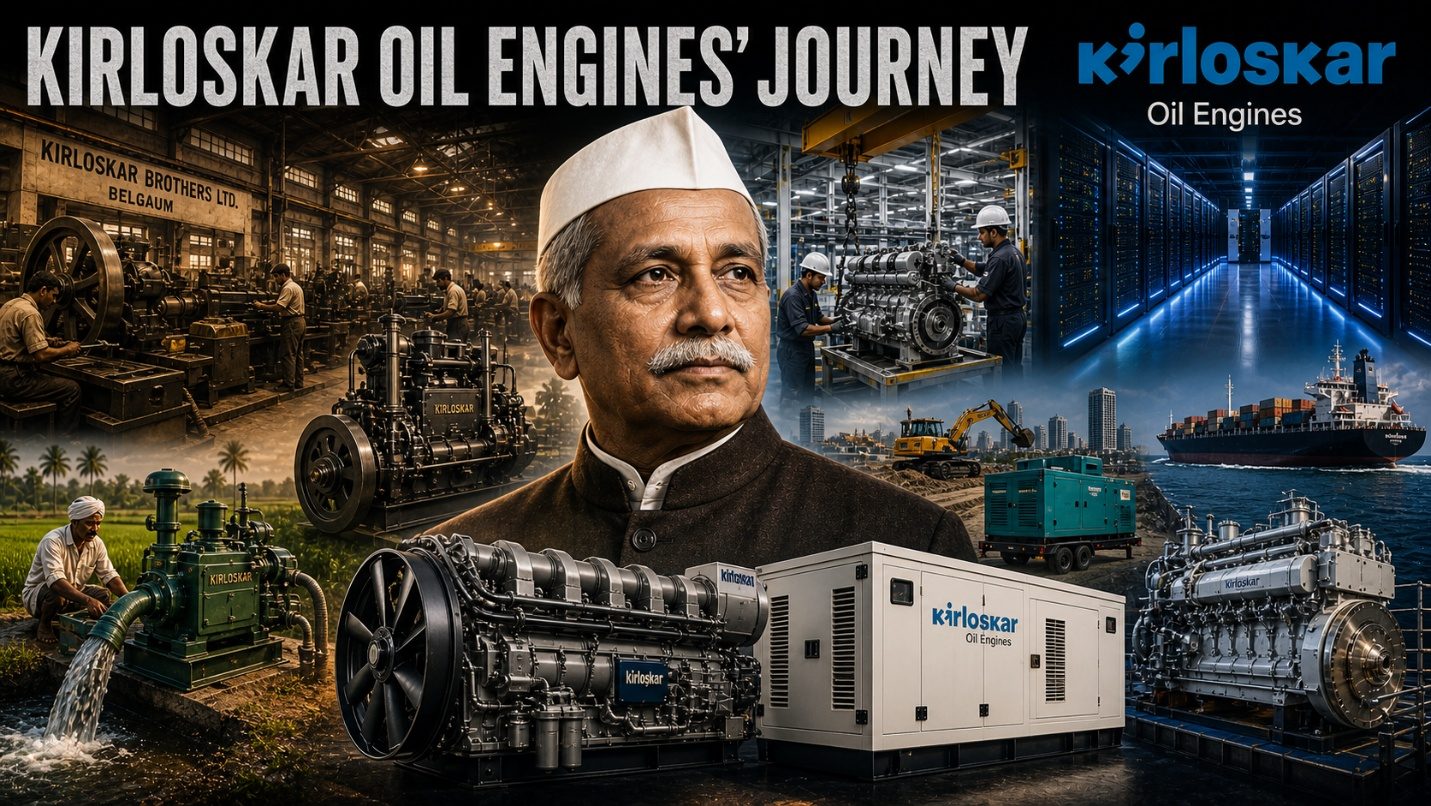
The Kirloskar name has been on Indian engines for more than 130 years, and the business has cycled through irrigation, construction, industry and now data centres. Kirloskar Oil Engines is proof that a century-old name can still compound, provided the underlying capability stays current with the cycle. Here is the journey, year by year.
- The Kirloskar Group was founded in 1888; Kirloskar Oil Engines was incorporated in 1946 for farm and industrial diesel engines.
- It became India’s largest diesel-engine and pump maker by 1965.
- A 2009 demerger listed it separately, with a focus on higher-horsepower industrial and power-generation engines.
- By FY25 revenue topped ₹6,000 crore, lifted by data-centre gensets and an agricultural recovery.
- FY25 Revenue tops ₹6,000 crore, with both genset and industrial-engine businesses contributing to growth.
1888 Laxmanrao Kirloskar founds the Kirloskar Group in Belgaum, one of India’s oldest industrial houses.
1946 Kirloskar Oil Engines is incorporated to make diesel engines for agriculture, irrigation and small industry.
1965 It becomes India’s largest diesel-engine and pump manufacturer.
1995 It diversifies into commercial gensets and industrial engines for construction equipment.
2009 It demerges from the erstwhile Kirloskar Oil Engines (renamed Kirloskar Industries) and lists separately, resetting strategy around higher-horsepower industrial and power-generation engines.
2018 Family-ownership reshuffles see strategy oscillate between consolidation and diversification.
2022 A services arm is hived off, refocusing the company on engines and gensets.
2024 The data-centre build-out creates a structural demand cycle for large gensets, while a good-monsoon agricultural-mechanisation cycle returns.
2025 The stock is a multibagger on a broad-based industrial recovery, and higher-horsepower genset capacity expansion is announced.
2026 Multiple engines compound at once, gensets for data centres, industrial engines for construction, agricultural pumps for irrigation, and marine engines for the navy and commercial shipping.
The pattern is the point
The Kirloskar name has been on Indian engines for over 130 years, and the business keeps cycling around irrigation, construction, industry and now data centres. A century-old name can still compound when the underlying capability stays current with the cycle, and the data-centre genset boom is the latest proof.