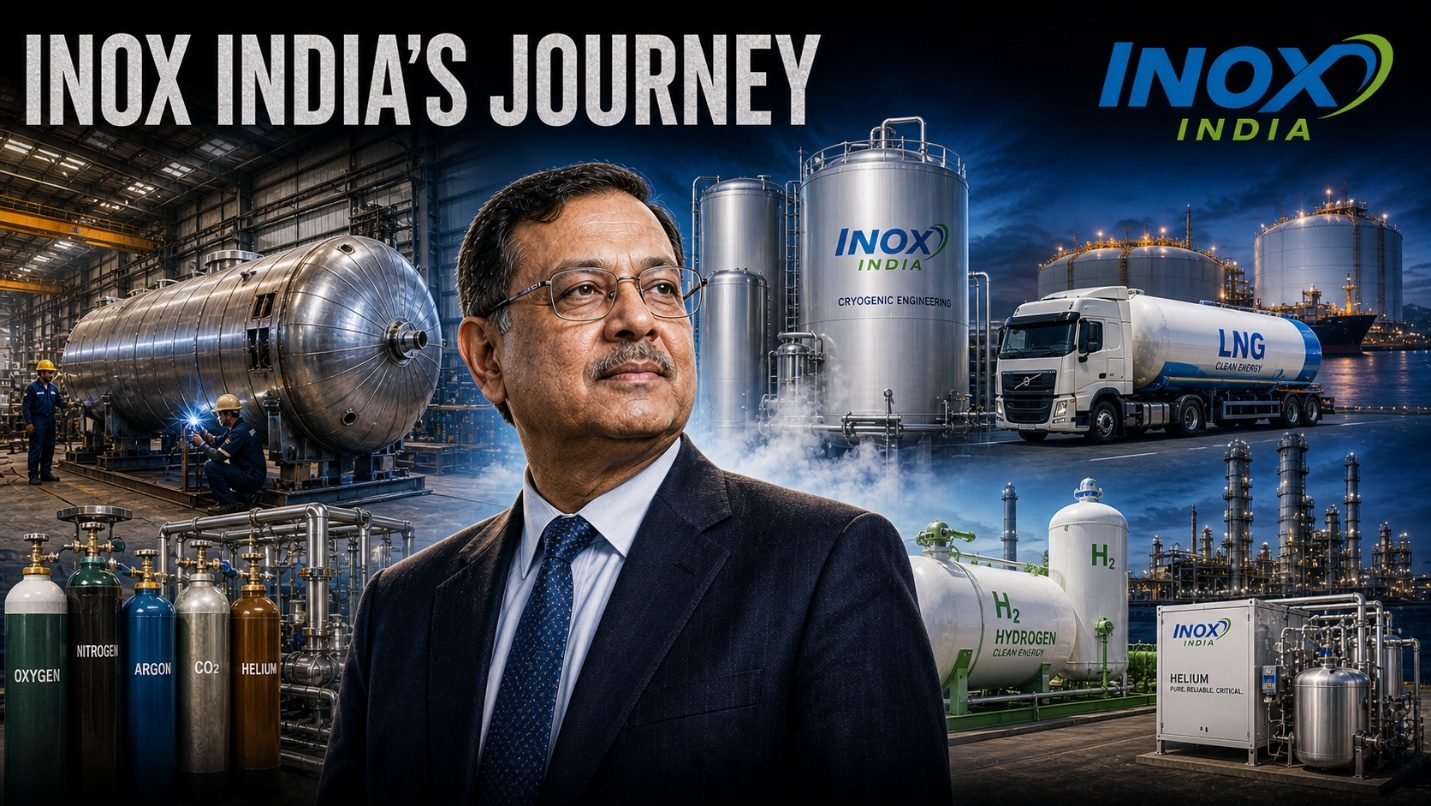
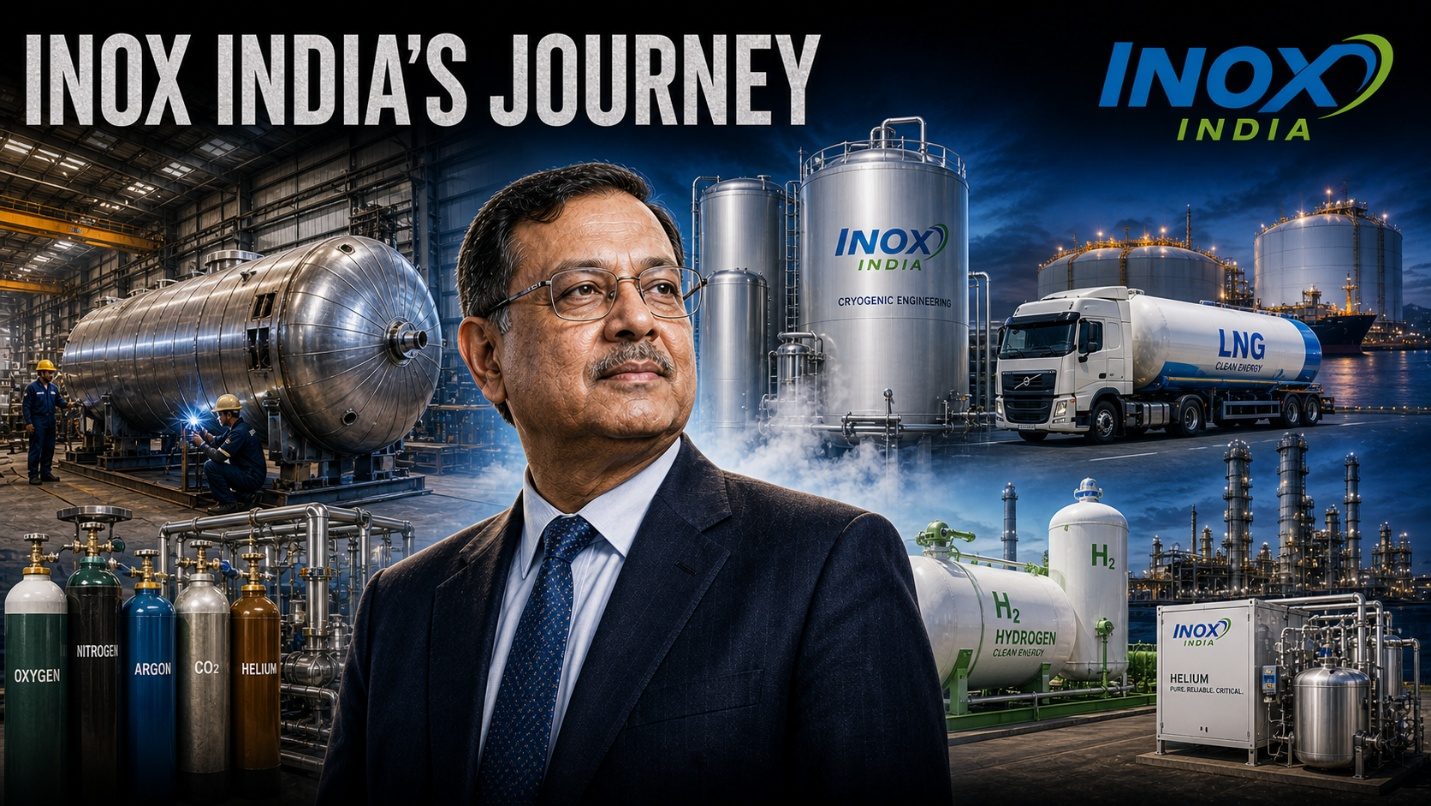
INOX India built the country’s cryogenic engineering capability for forty-five years before the market paid attention. When LNG, hydrogen and industrial gases all became thematic at once, the hardware was already there, making it the cleanest listed Indian play on the cryogenic side of the energy transition. Here is the journey, year by year.
- Established in 1976 to make cryogenic vessels and equipment in Vadodara.
- By 1985 it was India’s largest cryogenic engineering company, serving the armed forces, ISRO and global gas majors.
- Its December 2023 IPO was subscribed 61x and listed at a 40%+ premium.
- By FY25 revenue was around ₹1,300 crore with 20%+ margins, riding LNG, hydrogen and industrial-gas demand.
- FY25 Revenue runs around ₹1,300 crore with operating margins above 20% and an order book above ₹1,200 crore.
1976 The company (later INOXCVA) is established to manufacture cryogenic vessels and equipment in Vadodara.
1985 It becomes India’s largest cryogenic engineering company, with customers including the armed forces, ISRO, Linde, Air Liquide and Praxair.
1998 It expands into LNG storage tanks, betting early that India will move to natural gas as a transition fuel.
2010 It builds cryogenic capability for hydrogen, helium and other specialty gases, and begins exporting tanks to Europe and the Middle East.
2019 India’s LNG transportation market takes shape as Indian Oil and BPCL sign multi-year LNG procurement contracts.
Dec 2023 INOX India prices its IPO at ₹660, subscribed 61x, and lists more than 40% higher at around ₹950.
2024 LNG mobility-tank demand scales, hydrogen-storage orders begin, and industrial-gas customers in steel and chemicals add capacity.
2025 Three growth engines run together, LNG storage and mobility, hydrogen storage, and industrial gases for the steel and chemical capex cycle, with export capacity expansion guided.
2026 INOX India becomes the cleanest listed Indian play on the cryogenic and gaseous energy transition.
The pattern is the point
INOX India spent forty-five years building cryogenic capability before the market noticed, and that capability was already in place when LNG, hydrogen and industrial gases became thematic together. The transition winners are usually the companies that quietly built the hardware decades before the energy mix changed, and this is a textbook example.