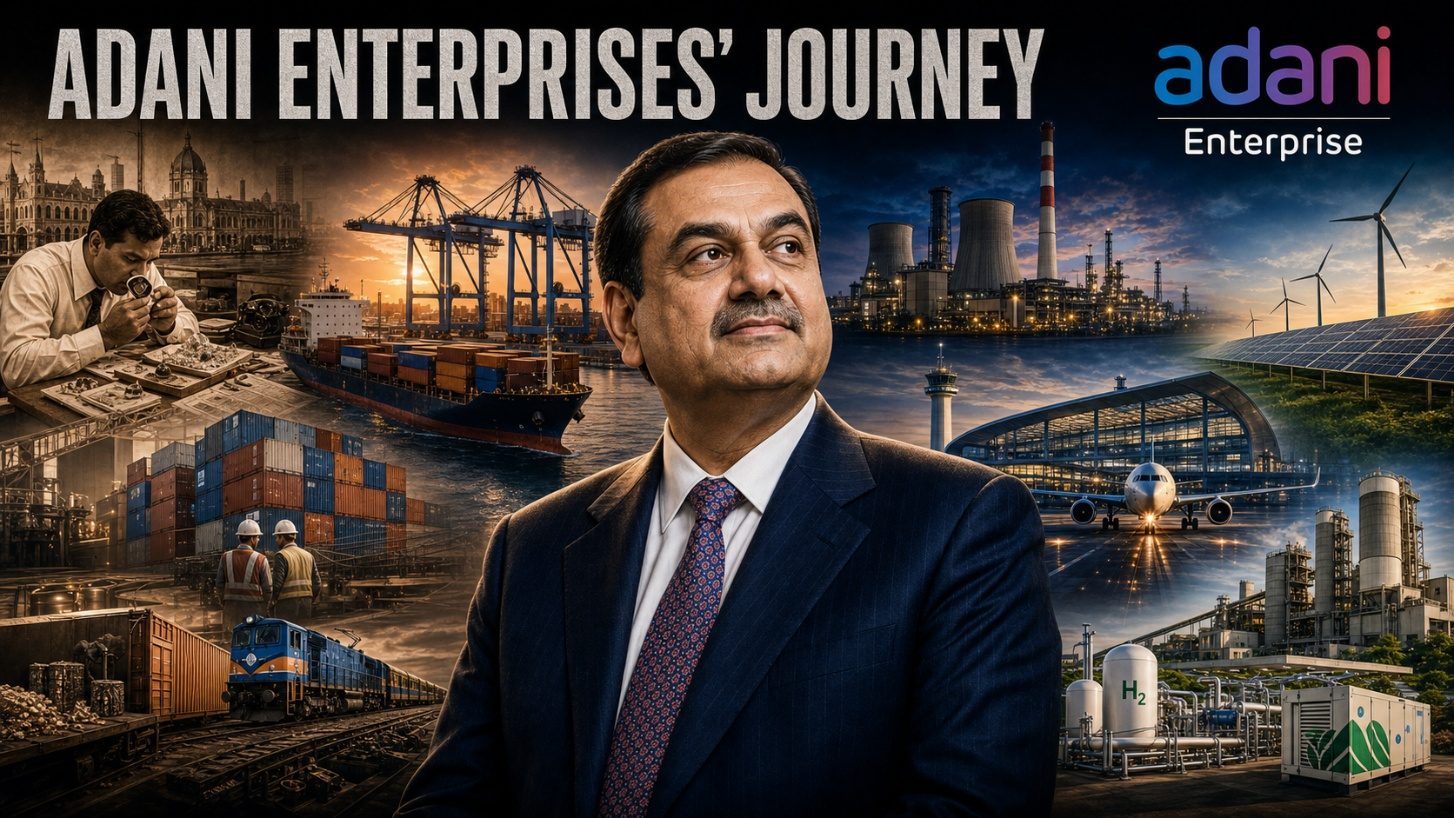
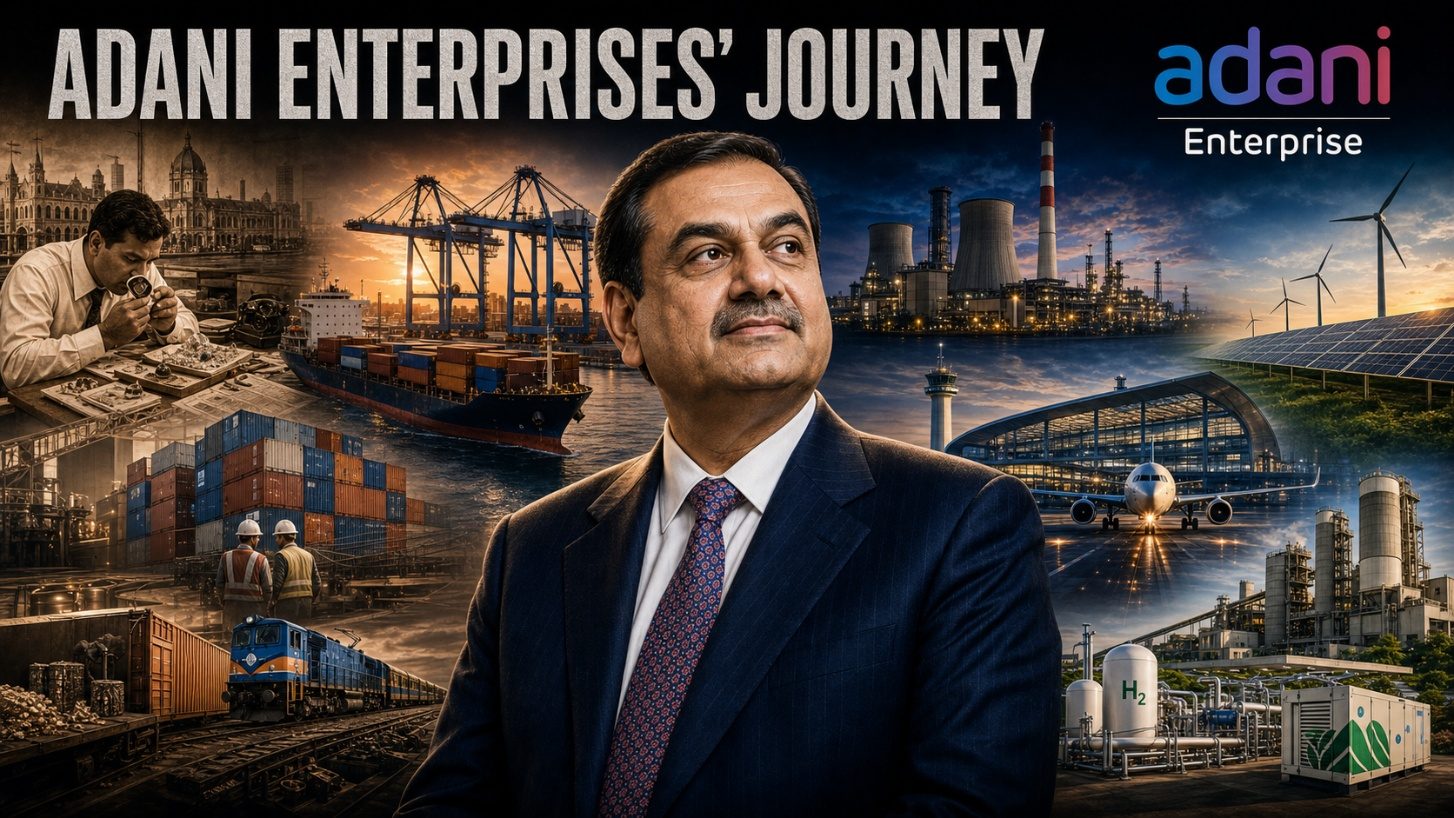
Adani Enterprises is the incubator at the centre of India’s largest infrastructure empire, the entity that has hatched ports, power, airports, cement, mining and renewables before spinning them out. Its founder started with ₹100 and a one-way ticket to Mumbai, and built a group that, through cycles, controversies and a full-blown short-seller crisis, kept moving cargo and generating power. Here is the journey, year by year.
- Gautam Adani left college at 16 with ₹100 to sort diamonds in Mumbai before founding Adani Exports in 1988.
- Mundra Port (from 1995) grew into India’s largest commercial port and the template for an infrastructure empire.
- The 2022 Holcim deal ($10.5 billion) made Adani India’s second-largest cement maker overnight.
- A 2023 short-seller report erased about $150 billion of group value in weeks; operations continued, and by 2026 the group had recovered to pre-crisis highs.
1978 Gautam Adani, aged 16, drops out of college and leaves Ahmedabad for Mumbai with ₹100, working as a diamond sorter.
1988 He founds Adani Exports, trading plastics, agricultural products and commodities, the seed of the group.
1995 Adani establishes Mundra Port in Gujarat, which eventually becomes the largest commercial port in India.
2002 Adani Power is formed, taking the group from trading and logistics into electricity generation.
2010 Listed group entities cross ₹50,000 crore in market value as Adani pushes into mining, edible oil and city gas.
2015 Adani makes its first major renewable-energy bet through Adani Green Energy.
2020 A privatisation wave hands Adani the airports of Mumbai, Ahmedabad, Lucknow, Jaipur and others, making it a major airports operator overnight.
2022 Adani becomes India’s second-largest cement company by buying ACC and Ambuja from Holcim for $10.5 billion.
Jan 2023 A Hindenburg Research short report triggers a rout, group stocks fall over 50% in three weeks, erasing roughly $150 billion of market value.
2023–2024 The group restructures, prepays debt and brings in marquee investors; the Supreme Court lets SEBI’s investigation continue, while the underlying operations run uninterrupted.
2024–2026 Group capex returns to record levels, Adani Green crosses 20 GW of renewable capacity, the defence and aerospace arm scales, and new green-hydrogen and copper projects begin.
2026 Adani stands as India’s largest infrastructure conglomerate, with listed group market value back to its pre-crisis highs.
The pattern is the point
Adani built the infrastructure the Indian state wanted built, ports, airports, power, cement, defence and renewable energy, and through every cycle, controversy and crisis the underlying assets kept moving cargo, generating power and earning concession income. The lesson of the numbers is that infrastructure cash flows are slower than equity narratives, and also more honest: the share prices swung violently in 2023, but the ports and plants never stopped running.