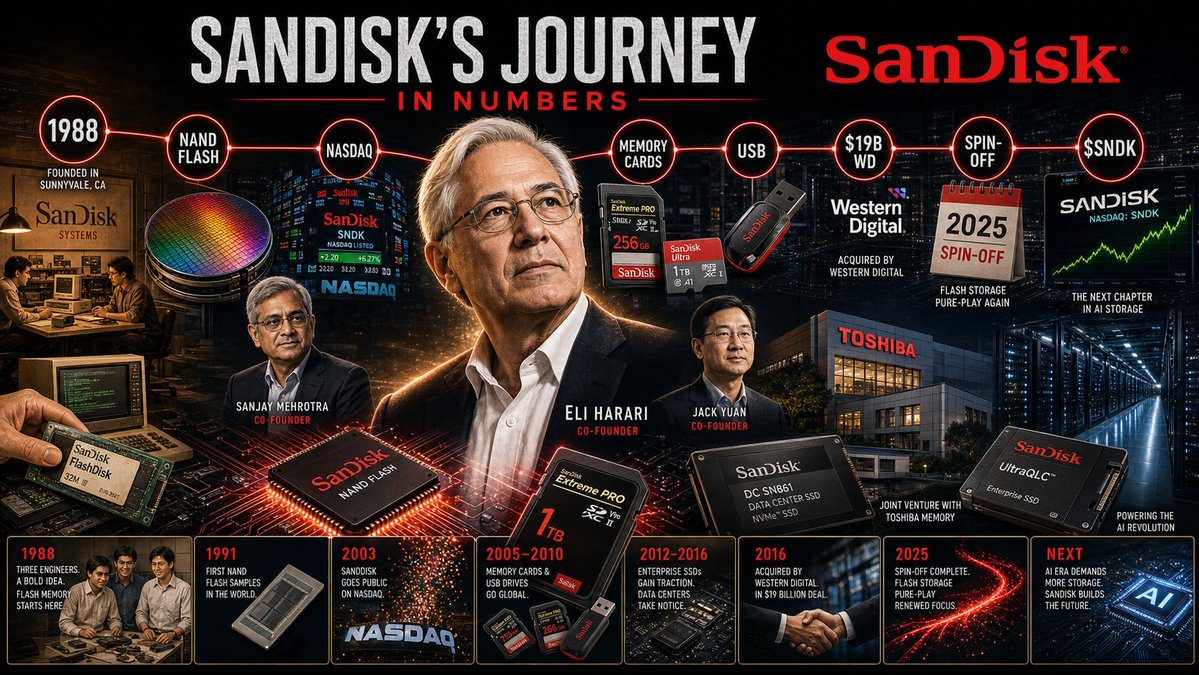
SanDisk was right about flash memory before the world believed it, and the early bet on NAND turned a small Sunnyvale start-up into the company behind nearly every memory card on earth for fifteen years. Absorbed by Western Digital and then spun back out, it arrived as an independent pure-play just as AI began demanding more storage than the cloud had ever consumed. Here is the journey, year by year.
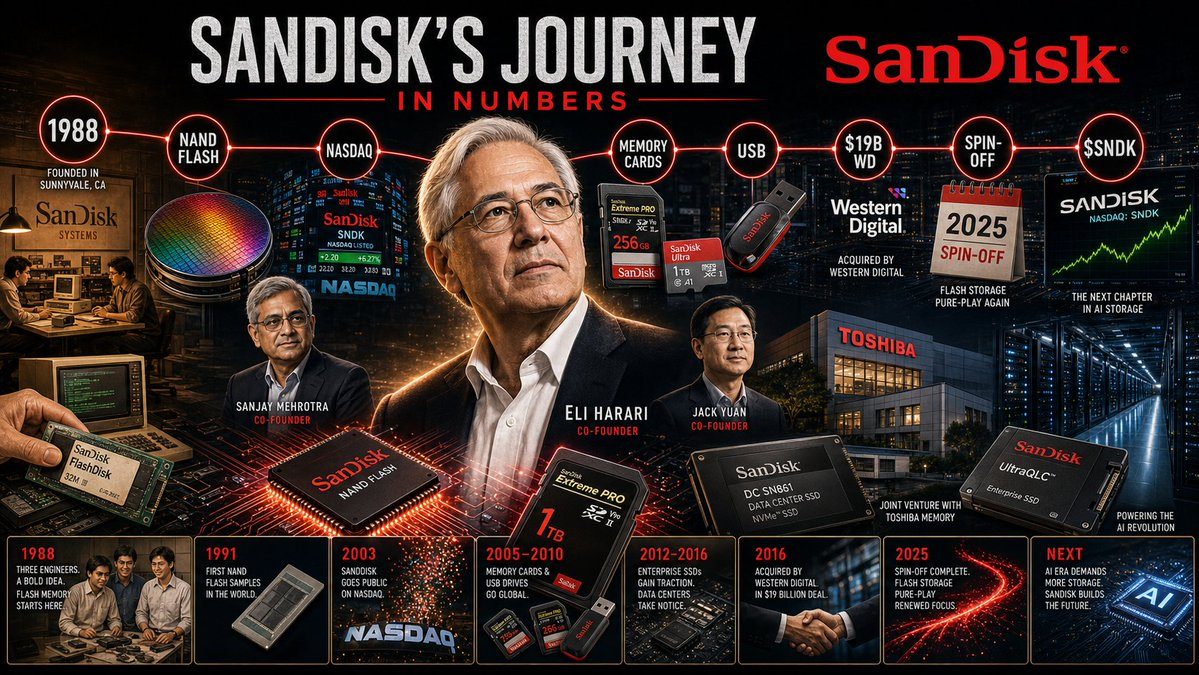
- Founded in 1988 on the bet that NAND flash would replace hard drives, a view the market did not share.
- It became the world’s largest supplier of flash memory cards, funded by a long-running fab joint venture with Toshiba.
- Western Digital completed its acquisition in 2016 — announced at $19 billion in 2015, closed at ~$16 billion; the integrated vehicle struggled through hard NAND price cycles.
- Spun off again in February 2025 (Nasdaq: SNDK), it re-emerged as a rare US-listed pure flash play just as AI storage demand turned up.
1988 Eli Harari, Sanjay Mehrotra and Jack Yuan found SanDisk in Sunnyvale, betting NAND flash will one day replace hard drives, a view the market does not share.
1991 It ships its first commercial flash-memory device.
1995 SanDisk lists on Nasdaq.
Late 1990s It survives the early flash-industry shakeout that kills many competitors.
2000 NAND flash demand takes off with digital cameras.
2006 It acquires M-Systems for $1.55 billion, picking up USB flash-drive technology.
2013 It buys SMART Storage Systems (~$307 million) to enter enterprise SSDs.
2016 Western Digital completes its acquisition of SanDisk — announced at $19 billion in 2015, closed at ~$16 billion — and SanDisk becomes a division of WD.
2018–2024 NAND prices cycle hard, and the integrated WD-SanDisk vehicle struggles to extract value from the combined assets.
Feb 2025 SanDisk is spun off from Western Digital (separation completed Feb 21; Nasdaq trading begins Feb 24 under SNDK).
2025–2026 Independent again, it refocuses on AI-server SSDs, mobile flash and consumer storage as the NAND cycle turns positive and AI-driven storage demand grows.
2026 SanDisk re-emerges as one of the few US-listed pure plays on flash memory, just as the next cycle begins.
The pattern is the point
SanDisk saw flash before the world did, and that conviction built the company that supplied a generation of memory cards. Few companies get a second life as a standalone public name; SanDisk got one in 2025, and it arrived just before AI turned storage into a growth market again. Being early is only valuable if you survive long enough to be there when demand finally shows up.