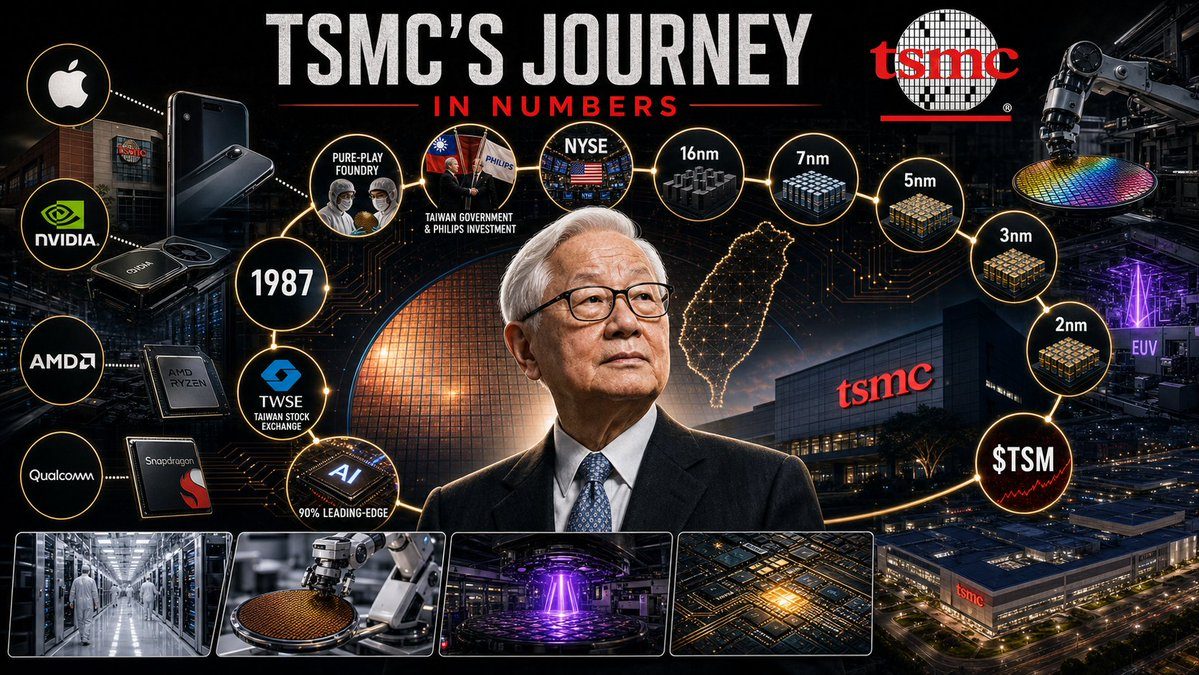
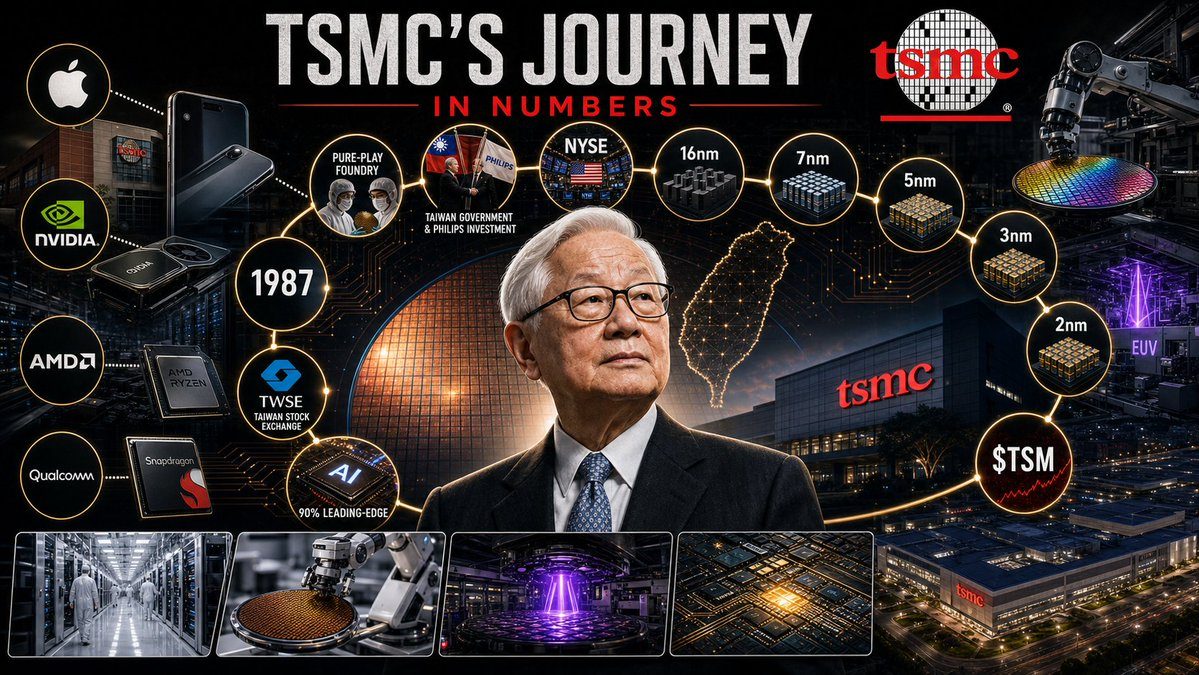
TSMC was built on one heretical idea: that designing chips and manufacturing them should be two different businesses. In 1987 the entire semiconductor industry was integrated and the consensus was that a Taiwanese pure-play foundry would never work. Four decades later it is the only model that exists at scale, and nearly all the world’s advanced chips are made in TSMC’s fabs. Here is the journey, year by year.
- Morris Chang founded TSMC in 1987 after being passed over at Texas Instruments; the pure-play foundry idea was widely dismissed.
- By separating design from manufacturing, TSMC became the fab for Apple, NVIDIA, AMD and Qualcomm, companies that design but do not build.
- A decisive 7nm lead opened in 2018 over Samsung and Intel and was never closed.
- By 2026 TSMC holds roughly 70% of the foundry market and makes an estimated ~90% of the world’s leading-edge chips.
1985 At 53, Morris Chang, passed over for the top job at Texas Instruments after a 25-year career, is recruited by Taiwan’s government to help build a semiconductor industry there.
1987 Chang founds TSMC, with Taiwan’s government holding 48% and Philips 27.5%; Texas Instruments declines to invest. The insight nobody else backed: one company should manufacture chips for everyone who only designs.
1994 TSMC lists on the Taiwan Stock Exchange.
1997 It becomes the first Taiwanese company listed on the New York Stock Exchange.
2000s TSMC becomes the foundry for a new generation of fabless firms, Apple, NVIDIA, AMD, Qualcomm, each of which designs and none of which manufactures.
2009 As the financial crisis hits, Morris Chang returns as CEO and doubles down on capital spending while competitors cut, widening its lead.
2015 Its 16nm FinFET process wins a share of Apple’s A9 business in a dual-sourcing split with Samsung.
2018 At 7nm a decisive lead opens over Samsung and Intel that Intel never closes; Morris Chang retires as chairman at 86.
2020 The 5nm node powers Apple’s M1 and A14.
2022 The 3nm node arrives, and TSMC announces a US fab build-out in Arizona that eventually expands to $165 billion.
2024 2nm pilot production begins; TSMC makes an estimated 90% of the world’s leading-edge chips and becomes Asia’s most valuable company.
2026 With roughly 70% of the global foundry market, nearly all AI compute, advanced smartphones and leading-edge processors are made in TSMC’s fabs.
The pattern is the point
The pure-play foundry model the entire industry rejected in 1987 is now the only one that exists at scale. Morris Chang built TSMC by separating design from manufacturing at the precise moment everyone else was integrating, and then compounding that single decision for forty years. Strategic clarity, applied relentlessly, turned a government-backed start-up into the most critical company in the global technology supply chain.