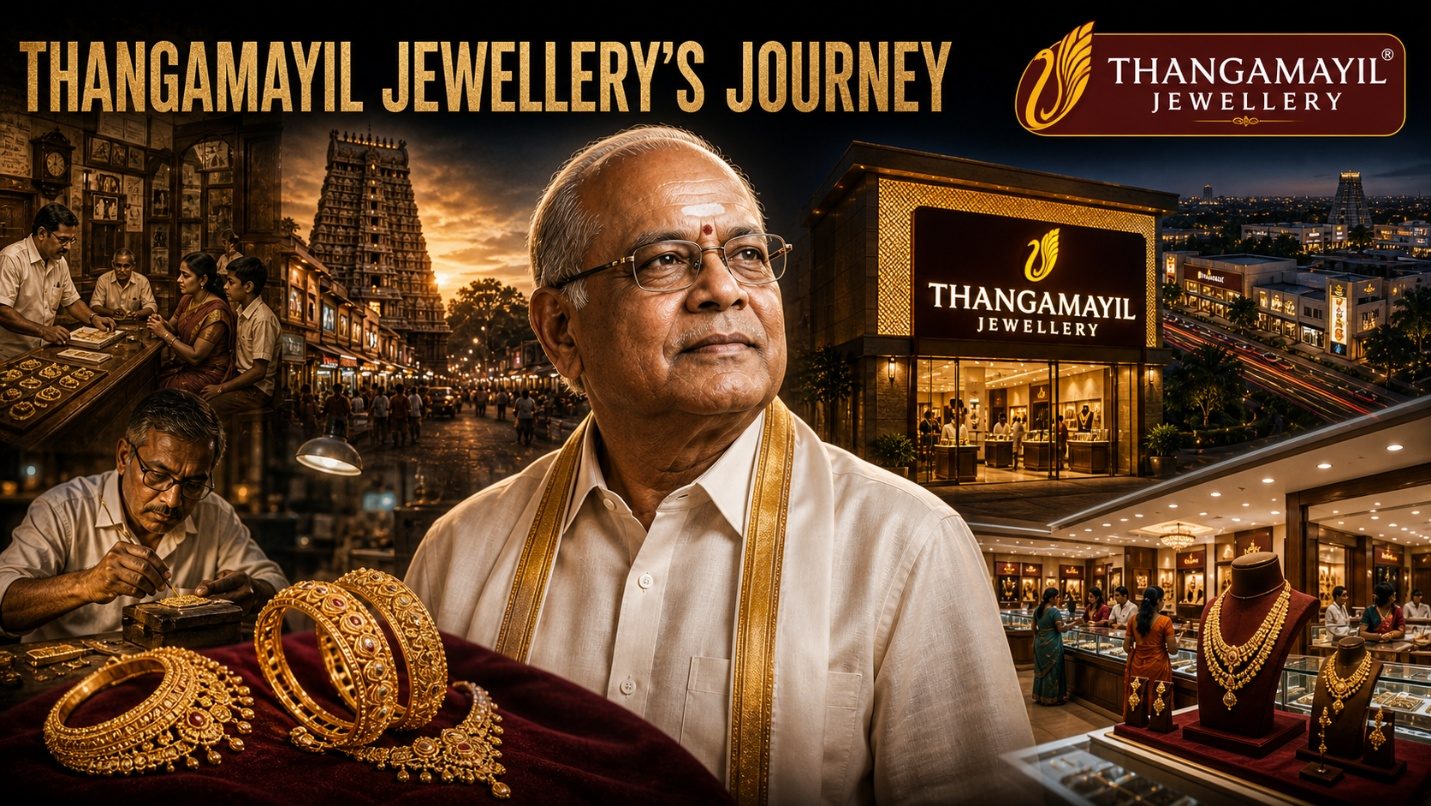
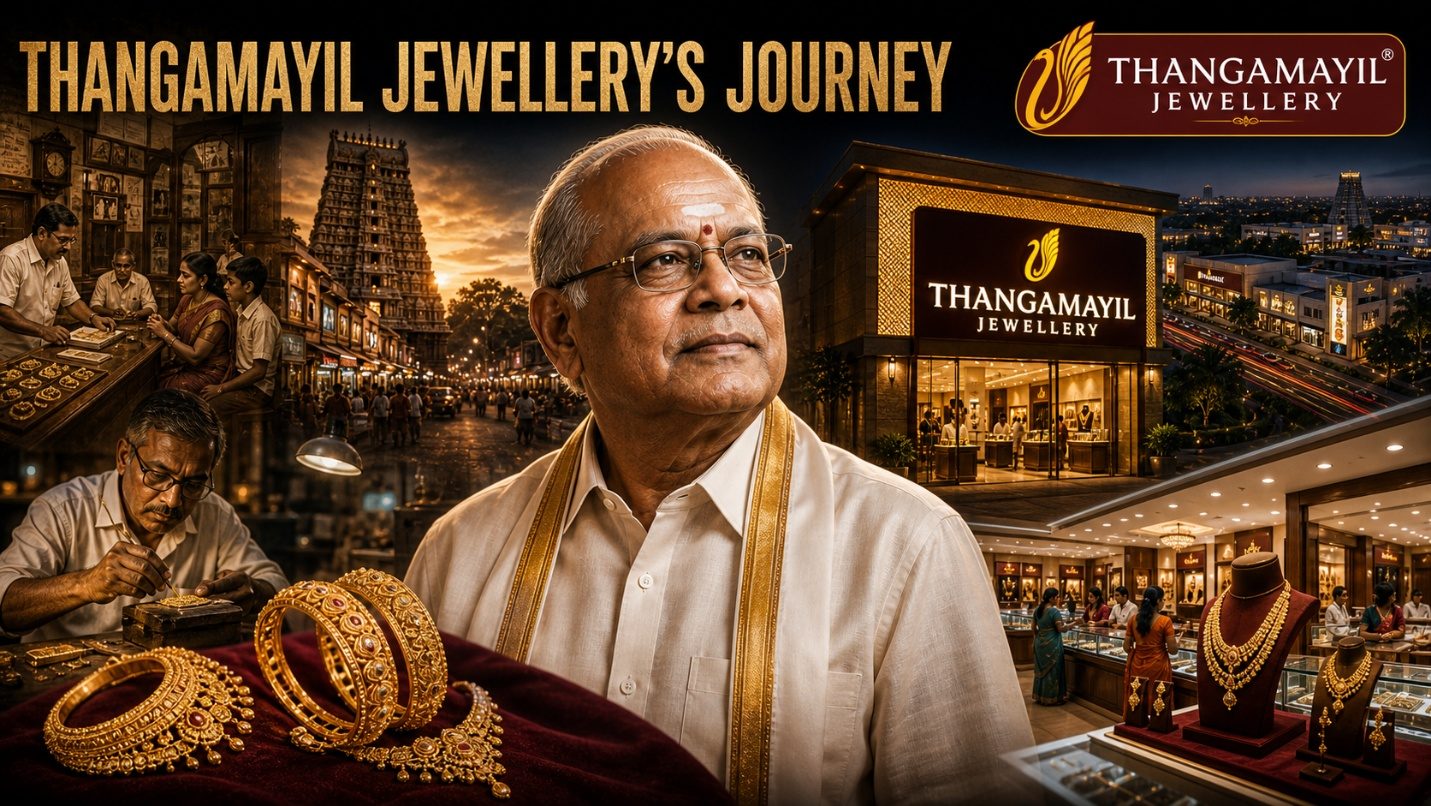
Thangamayil is not Titan, and that is the point. It is what regional consumption looks like when a family picks a single state and sets out to own it, a narrower franchise, a local moat, and compounding that is very real. Here is the journey of a Madurai jeweller that grew with the South Indian household, year by year.
- Founded in Madurai in 1947 as a traditional family jeweller for the temple-town middle class.
- It expanded district by district across southern Tamil Nadu, a deliberately regional rather than national bet.
- A gold-led product mix benefited disproportionately as gold prices rose from 2019.
- By FY25 revenue topped ₹4,500 crore with some of the strongest same-store sales in listed Indian jewellery, across 60+ showrooms.
- FY25 Revenue tops ₹4,500 crore, with same-store sales growth among the strongest in listed Indian jewellery.
1947 Founded in Madurai as a traditional family jeweller serving the temple-town middle class.
1980 It builds out across southern Tamil Nadu, district by district, a regional bet, not a national one.
2000 Expansion accelerates within the Madurai region, and the brand becomes synonymous with daily-wear gold for middle-class South Indian customers.
2010 Thangamayil lists on the BSE.
2014 Same-store sales compound at industry-leading rates, with new stores added at a measured pace and tight inventory discipline.
2019 A multi-year rise in gold prices begins, and Thangamayil’s gold-led mix benefits disproportionately.
2022 COVID disruption accelerates the trust shift toward organised regional jewellers.
2024 A record gold rally and accelerating expansion into tier-2 and tier-3 towns broaden the franchise beyond southern Tamil Nadu.
2025 Network expansion into Coimbatore, Tiruchirappalli, Salem and the Chennai outer suburbs continues, with more tier-2 and tier-3 rollout guided.
2026 With over 60 showrooms across Tamil Nadu, the franchise compounds with the South Indian household balance sheet.
The pattern is the point
Thangamayil shows what regional consumption looks like when a family picks one state and owns it: the franchise is narrower than a national chain, the moat is local, and the compounding is real. It is a regional brand, held by patient family management, sitting inside the strongest consumer category of the cycle, gold, as South Indian households grew wealthier.