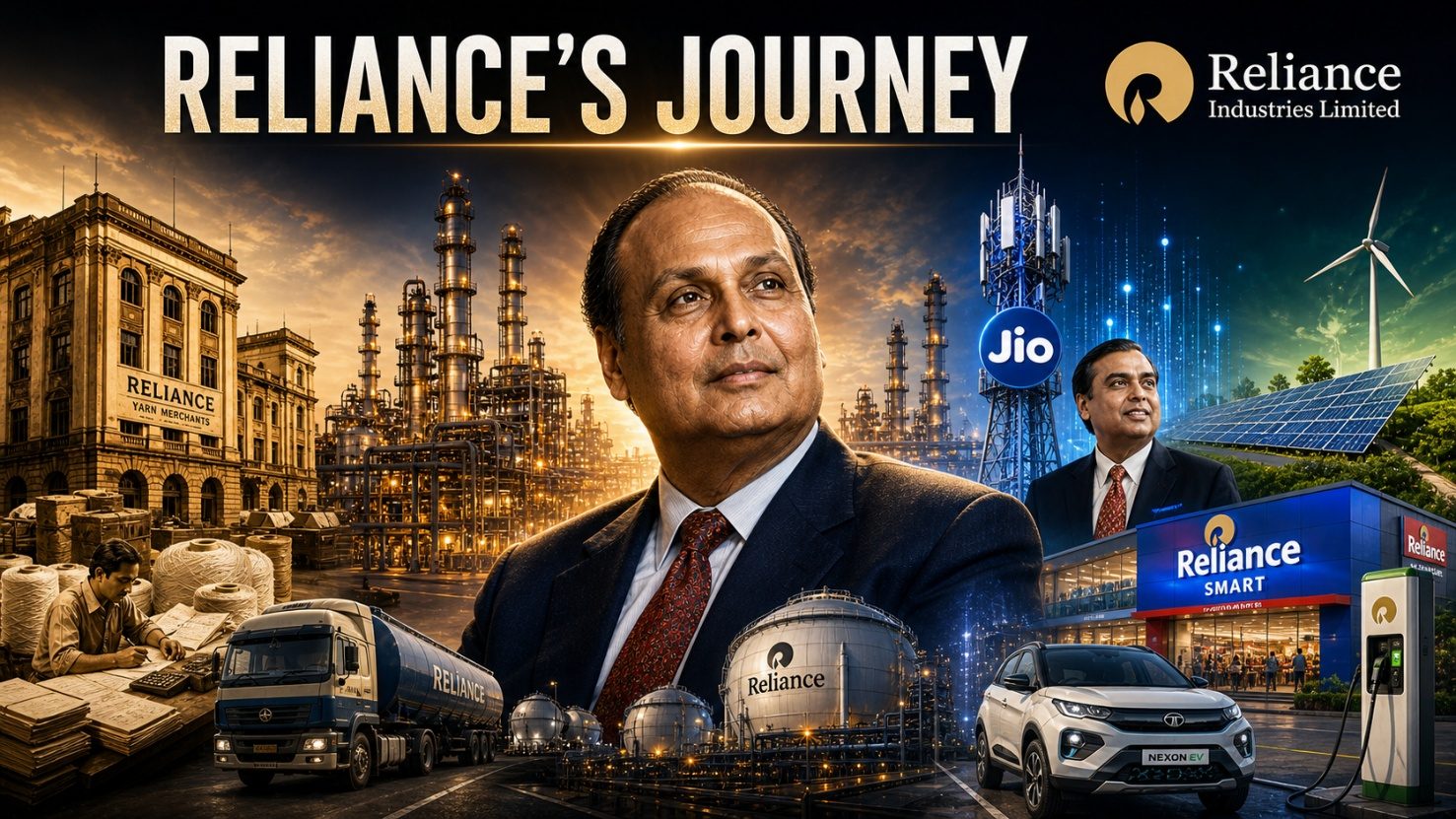
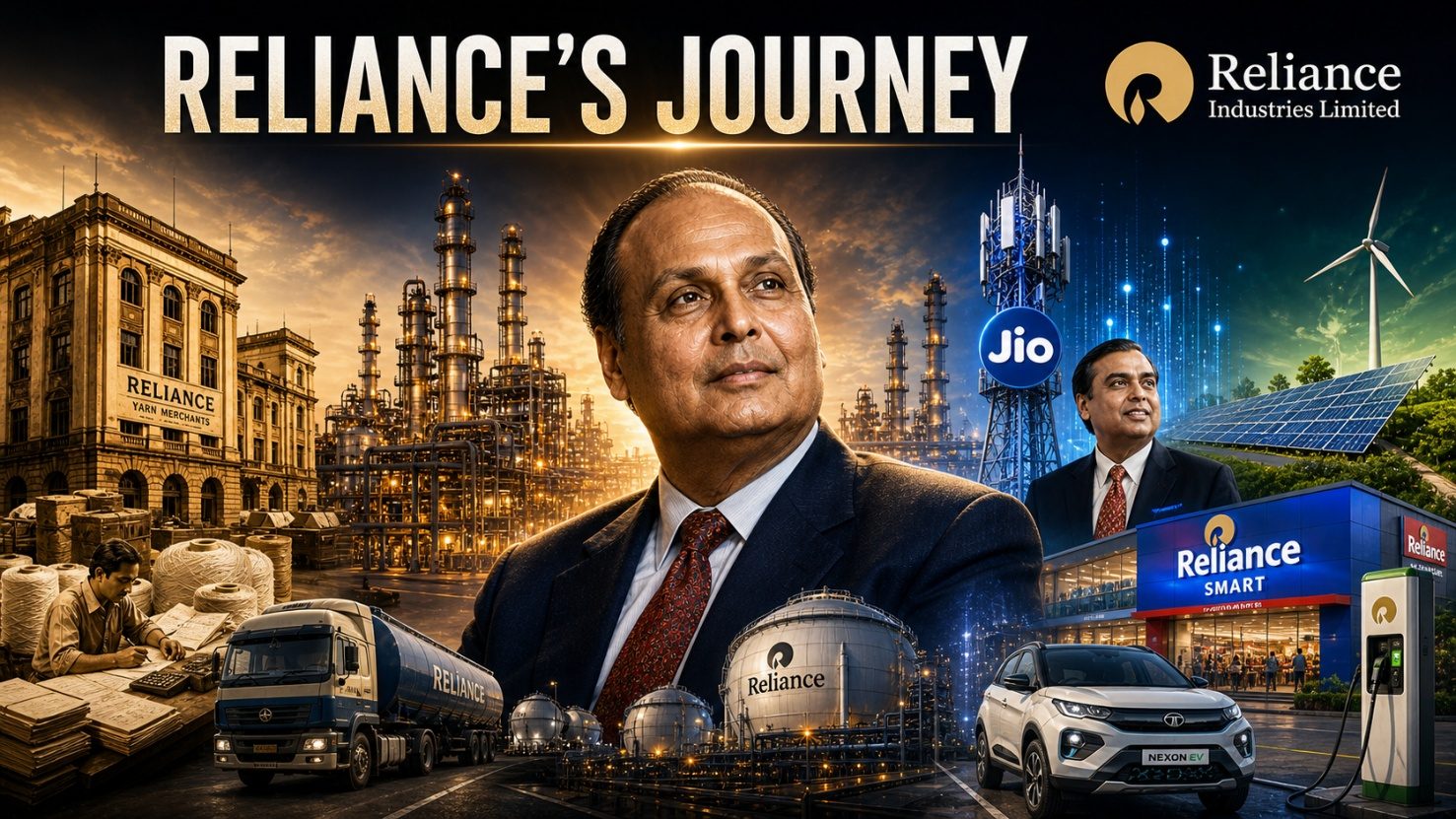
Few corporate stories capture India’s own economic arc like Reliance. It begins with a young man stepping off a boat from Aden with a few hundred dollars, and it reaches, so far, the most valuable company the country has ever produced. Along the way Reliance has done something almost no large company manages even once: it has torn up and rebuilt its core business three separate times, textiles into petrochemicals, petrochemicals into digital, and now digital into new energy. Here is that journey, year by year.
- Reliance grew from Dhirubhai Ambani’s roughly $700 yarn trade in 1958 into India’s most valuable listed company by 2026.
- Its 1977 IPO became market folklore, early retail holders compounded at over 20% a year for four decades.
- The Jamnagar refinery (1999) became the world’s largest single-site refinery; Jio (2016) then built a second growth engine from scratch.
- Reliance is reinventing again, committing ₹75,000 crore (about $9 billion) to five new-energy gigafactories at Jamnagar.
1958 Dhirubhai Ambani returns to Bombay from Aden, where he had worked as a clerk and petrol-pump attendant, with roughly $700 to his name. He starts by trading yarn for the city’s textile mills, learning the commodity trade from the inside.
1966 He founds Reliance Textiles and soon moves from trading cloth to making it, on the belief that owning the manufacturing, not just the trade, is where the money compounds.
1977 Reliance goes public in an IPO that becomes part of Indian market folklore. The retail investors who bought that float, and held, would compound their money at over 20% a year for the next four decades, helping build India’s equity-owning middle class.
1981 The first polyester filament plant opens at Patalganga, and Reliance begins its signature move, backward integration, climbing from fabric to fibre to the petrochemicals that make it, capturing margin at every step of the chain.
1999 The Jamnagar refinery begins operations and eventually becomes the largest single-site oil refinery in the world, turning Reliance from a textiles-and-chemicals group into one of the planet’s great energy companies.
2002 Dhirubhai dies suddenly, without a will, and the empire is eventually split between his sons. Mukesh keeps the oil, petrochemicals and the yet-unborn digital business, the half that would go on to dominate.
2010 Reliance acquires a little-known company called Infotel, and the broadband spectrum that comes with it. Almost no one notices at the time. It is the seed that will become Jio.
2016 Jio launches with six months of free voice and 4G data, detonating India’s telecom market. The country goes from roughly 200 million internet users to 700 million in about five years, and Reliance has built an entirely new core business from zero.
2020 In the depths of the pandemic, Reliance raises about $20 billion for Jio Platforms from Meta, Google, KKR, the Saudi PIF and others, the largest fundraising in Indian corporate history, and uses it to cut net debt to near zero.
2021 Reliance commits ₹75,000 crore (around $9 billion) to a new-energy push: five gigafactories at Jamnagar for solar panels, batteries, electrolysers, fuel cells and power electronics, its third reinvention, this time into clean energy.
2024–2025 The media arm merges Jio, Hotstar and Disney’s India business into a streaming-and-TV giant, while Reliance Retail crosses 19,000 stores, the largest retail footprint in the country, serving more than a billion transactions a year.
2026 Reliance stands as India’s most valuable company, running three engines in parallel, oil-to-chemicals, digital and retail, with new energy spinning up as a fourth; its first 40 GWh battery gigafactory at Jamnagar is being commissioned.
The pattern is the point
From $700 of yarn to the country’s largest refinery, its biggest telecom network and its largest retailer, Reliance has rewritten its core business three times, and each time, the next leg was already being built while the old one was still printing cash. That is the real lesson of the numbers: reinvention treated not as a crisis response but as a permanent balance-sheet strategy. For investors, it is also a reminder that the company’s next chapter, new energy, is being funded today out of the cash flows of the last one.