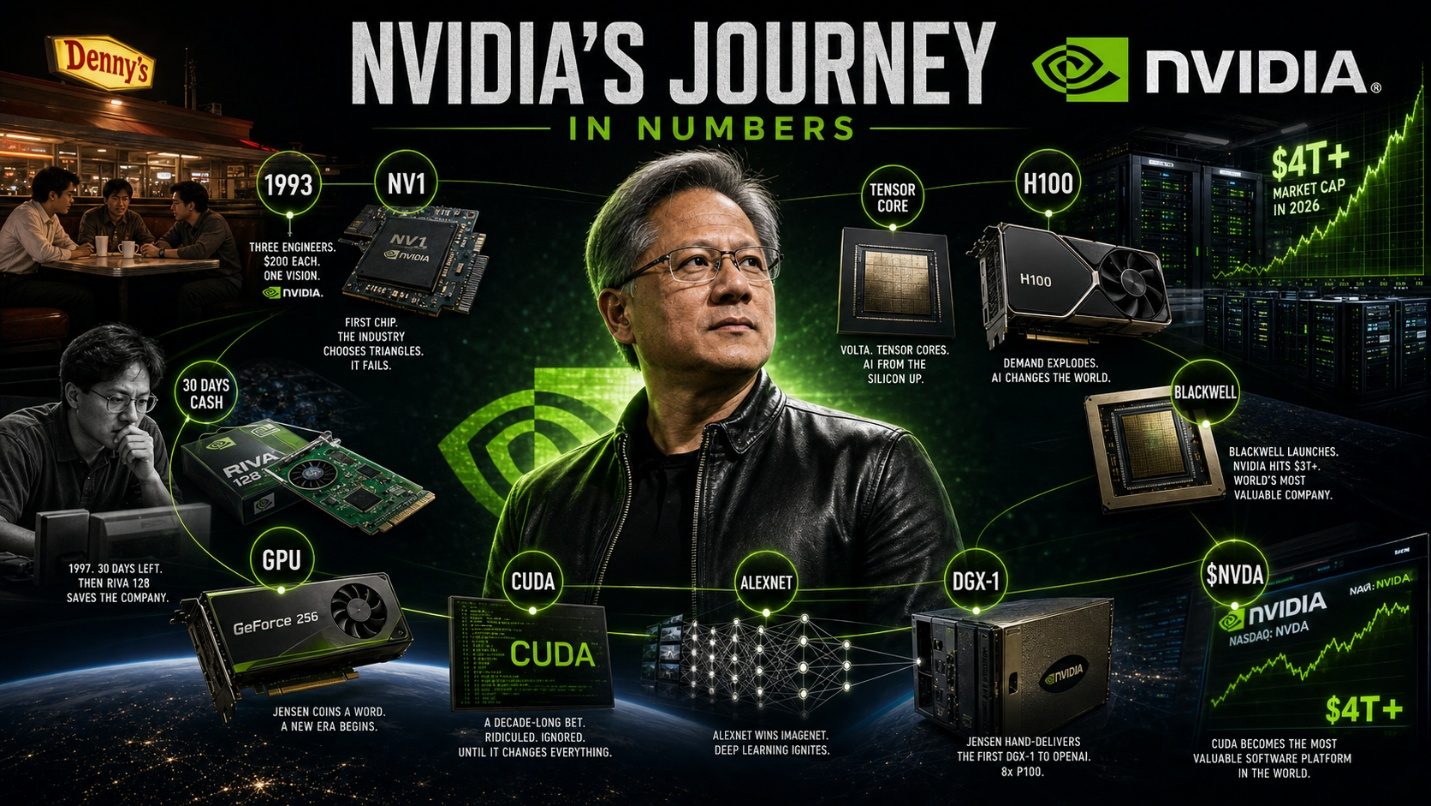
It is the defining company of the AI era, but it nearly died twice and was mocked for a decade in between. Here is NVIDIA’s climb, year by year.
1993 Three chip engineers, Jensen Huang, Chris Malachowsky and Curtis Priem, meet over coffee at a Denny’s in San Jose, each put in $200, and bet that 3-D graphics will reshape computing. They name the company NVIDIA.
1995 Their first chip, the NV1, bets on curved “quadratic” surfaces just as the industry, led by Microsoft’s new DirectX standard, settles on triangles. Incompatible with the games that matter, it flops.
1996 Sega, which had backed NVIDIA’s approach for its consoles, cancels the follow-on NV2. The young company is months from death, and Huang lays off more than half his staff to survive.
1997 With roughly thirty days of cash left, NVIDIA ships the RIVA 128, fast, cheap and, crucially, compatible. It sells a million units in four months and saves the company at the last possible moment.
1999 NVIDIA goes public at $12 a share. The same year it launches the GeForce 256 and coins a term for it that sticks to the whole industry: the GPU, the graphics processing unit.
2006 NVIDIA releases CUDA, software that lets ordinary programmers harness the GPU for general maths, not just graphics. Wall Street sees only the spending and no market, and punishes the stock for years; Huang keeps funding it anyway.
2012 A neural network called AlexNet, trained on a pair of NVIDIA gaming GPUs, crushes the field in the ImageNet image-recognition contest. Deep learning erupts, and CUDA, ridiculed for six years, turns out to be the platform it all runs on.
2016 Huang personally hand-delivers and signs the first DGX-1 AI supercomputer, eight high-end GPUs in a single box, for a young lab called OpenAI. The hardware supply chain of the AI age quietly begins.
2017 The Volta architecture introduces Tensor Cores, circuitry purpose-built for the matrix maths of AI, cementing the GPU as the engine of machine learning.
2022 ChatGPT launches and the world races to build AI. Every model needs NVIDIA’s H100 chips, and the company cannot make them fast enough; the H100 becomes the most sought-after hardware on the planet.
2023 Riding the AI boom, NVIDIA’s market value crosses $1 trillion, joining a club until then reserved for a handful of consumer-tech giants.
2024 The Blackwell generation arrives and the market cap vaults past $3 trillion, making NVIDIA, at times, the most valuable company in the world, a former graphics-card maker now at the centre of the global economy.
2025 NVIDIA unveils its next platform, Rubin, around which the entire 2026 wave of AI data-centre spending is being planned. It is no longer selling chips so much as the blueprint for AI infrastructure.
2026 NVIDIA’s market value tops $5 trillion. CUDA, once the most mocked R&D bet in semiconductor history, is now widely called the most valuable software platform in the world, the moat beneath the AI age.
The pattern is the point
They nearly died in 1997 and were ridiculed for ten years over CUDA. The market does not reward strategic bets until the moment it does, and then it rewards them all at once. The decade-long platform bet pays the largest dividend, but only to the team willing to live through the decade.
This blog is for information and general interest only. It is not investment advice or a recommendation regarding any company or security. Figures and dates are drawn from public sources.