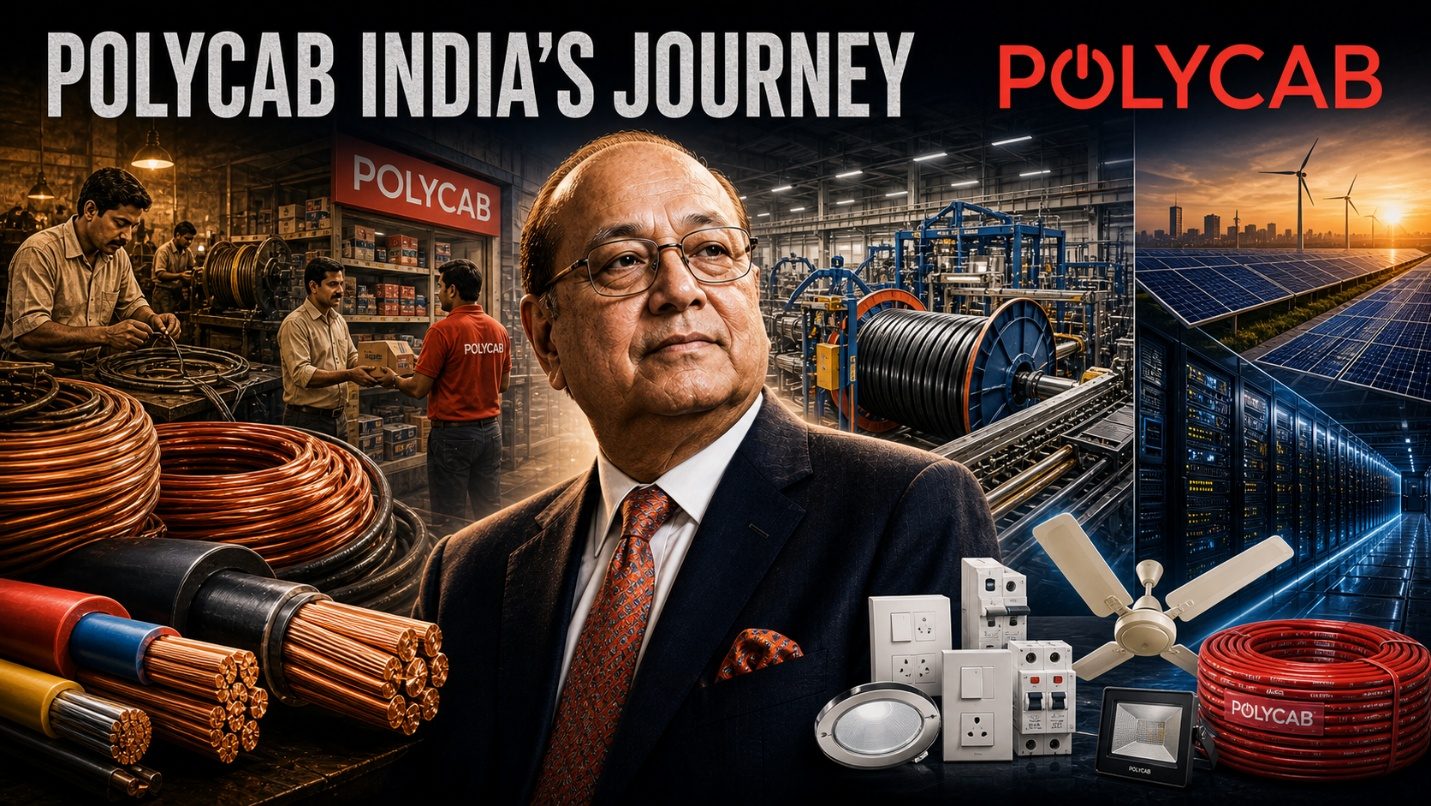
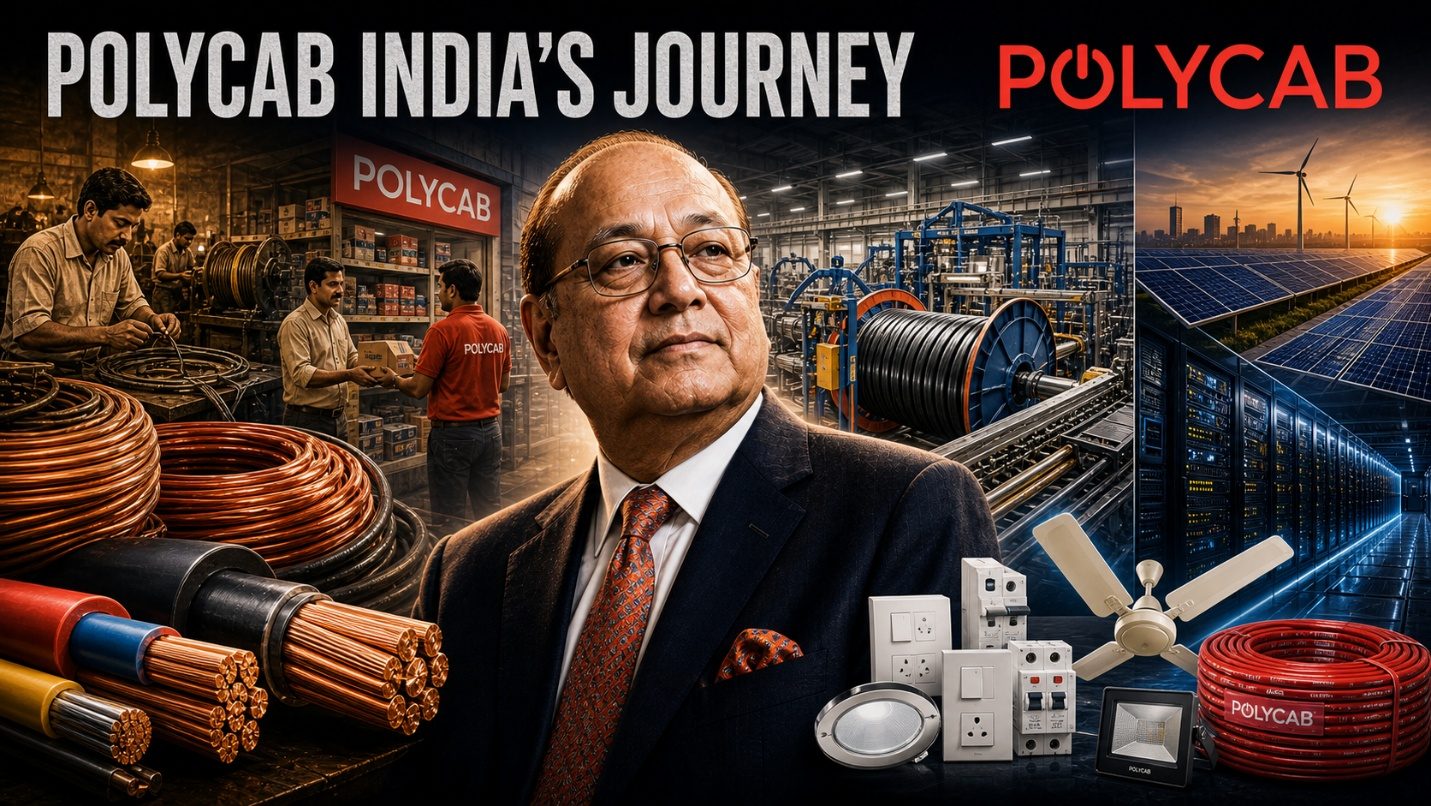
Polycab is, at heart, a sixty-year distribution machine. The Jaisinghani family built a value-for-money wires brand that became the default choice of the Indian electrician and contractor, and when it finally listed in 2019, the market simply got to participate in a playbook the family had been running privately for decades. Here is the journey, year by year.
- Founded in 1964 in Mumbai; distribution to electricians and contractors became its enduring moat.
- It listed in April 2019 (subscribed 51x) and compounded revenue at over 25% a year through the infrastructure cycle.
- It entered major mid-cap indices through the cycle, including the Nifty Midcap 100.
- By 2026 it is India’s largest wires-and-cables maker, with three growth engines and a market cap above ₹1 lakh crore.
- FY25 Revenue rises 24% to ₹22,408 crore with about ₹2,020 crore profit, and the consumer-electricals business crosses ₹1,500 crore.
1964 The Jaisinghani family’s electrical business takes root in Mumbai (Sind Electric Stores); Polycab is later founded in 1983 by Inder T. Jaisinghani and his brothers, in a market led by foreign brands and a few large Indian players.
1980–1995 Polycab becomes the value-for-money brand of choice for electricians and contractors, with distribution as the moat.
2000 It diversifies into electrical accessories, switches, switchgear, fans and lighting, and becomes a household name.
2009 It restructures group entities and builds modern manufacturing at Halol, Daman and Roorkee.
2014 Goldman Sachs invests, beginning strategic preparation for an IPO.
Apr 2019 Polycab lists at ₹538, subscribed 51x, and opens at ₹655, a 22% premium.
2020–2022 Rural electrification, real estate, infrastructure capex and B2C fans and lighting all compound at once, with revenue growing over 25% a year.
Dec 2022 Income-tax raids hit the stock, which corrects sharply; the company later confirms operations and compliance are unaffected.
Sep 2023 Polycab is a constituent of major benchmark indices, including the Nifty Midcap 100, as its scale grows through the cycle.
2024 Industrial-cable demand from renewable-energy, solar, wind and data-centre customers accelerates the B2B business.
2026 India’s largest wires-and-cables maker by revenue runs three engines together, B2B wires and cables, B2C consumer electricals, and industrial cable for solar and data centres, with a market cap above ₹1 lakh crore.
The pattern is the point
The Jaisinghani family built a distribution-led wires business for sixty years, and the post-listing compounding came from the very playbook they had been executing privately, the market simply got to join. The brand-and-distribution moats of industrial India compound across cycles in ways that look like luck from the outside and are anything but.